I/O-Efficient Permutation Algorithms: Lower Bounds and Indivisibility Model Analysis
This paper discusses the lower bounds of permuting N elements based on a given permutation, focusing on the I/O-efficient algorithms operating under the indivisibility model. In this model, elements can only be moved with allowed operations, and both copies and destruction of elements are permitted. We analyze the implications of memory and disk as arrays configured in tracks and present a method for estimating the number of permutations achievable with limited I/Os. Results include derivations on sorting lower bounds and implications for efficient data structure design.

I/O-Efficient Permutation Algorithms: Lower Bounds and Indivisibility Model Analysis
E N D
Presentation Transcript
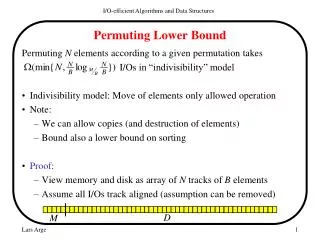
I/O-efficient Algorithms and Data Structures Permuting Lower Bound Permuting N elements according to a given permutation takes I/Os in “indivisibility” model • Indivisibility model: Move of elements only allowed operation • Note: • We can allow copies (and destruction of elements) • Bound also a lower bound on sorting • Proof: • View memory and disk as array of N tracks of B elements • Assume all I/Os track aligned (assumption can be removed) D M
I/O-efficient Algorithms and Data Structures Permuting Lower Bound • Array contains permutation of N elements at all times • We will count how many permutations can be reached (produced) with t I/Os • Input: • Choose track: N possibilities • Rearrange ≤ B element in track and place among ≤ M-B elements in memory: • possibilities if “fresh” track • otherwise at most permutations after t inputs • Output: Choose track: N possibilities D M
I/O-efficient Algorithms and Data Structures Permuting Lower Bound • Permutation algorithm needs to be able to produce N! permutations (using Stirlings formula and ) • If we have • If we have and thus
I/O-efficient Algorithms and Data Structures Sorting lower bound • Similar argument but assuming comparison model in internal memory • Initially N! possible orderings • Count how may possible after t I/Os Sorting N elements takes I/Os in comparison model