Understanding AR Verbs in Spanish: The Base and Flag System Explained
This guide explores how Spanish AR verbs are structured using a combination of a "base" and a "flag." Each verb has a base that conveys the core meaning, such as "habl" for "speak," while the flag (e.g., "ar") provides grammatical context including tense and subject. By altering the flag, we can change the verb's meaning to indicate actions in present tense, and characteristics like who is performing the action and when it happens. Discover how this system clarifies verb conjugation in the Spanish language.


Understanding AR Verbs in Spanish: The Base and Flag System Explained
E N D
Presentation Transcript
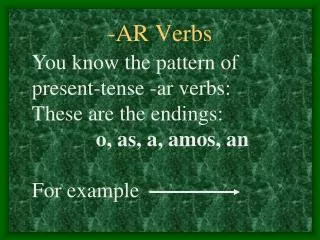
Flags • Each verb in Spanish combines a “base” with a “flag”. • “Hablar” for instance has a base called “habl” and a flag “ar”. • The base gives us the abstract idea “speak”. • And, the flag gives us the idea “to”. • If we change the flag to “o”, then this changes the meaning. • We add to the base “speak” the idea “I” (in the present tense).
Flags • Every “flag” adds an extra idea to the abstract “base”. • Each “flag” generates the following kinds of meaning: • It indicates who does the action (subject) • It indicates when the action occurs (time) • It indicates whether the action is perceived as real or imaginary (Mood: indicative/subjunctive)