Understanding Heat Transfer: Conduction, Convection, and Radiation Explained
Explore the fascinating world of heat transfer mechanisms that drive weather and climate on Earth. This video covers how the Sun warms our planet through conduction (heat transfer by direct contact), convection (movement of particles in liquids and gases), and radiation (transfer through electromagnetic waves). Learn how different materials conduct heat and discover practical examples to visualize these concepts. Perfect for students and anyone interested in the science behind temperature changes and weather patterns.

Understanding Heat Transfer: Conduction, Convection, and Radiation Explained
E N D
Presentation Transcript
Heat Transfer http://www.youtube.com/watch?v=ajQ3hm5JidU&safe=active Heat and Weather video 3:27
The Sun • The source of heat for our planet • Moves through space, then through the earth's atmosphere and finally reaches the earth's surface. • Warms the earth's atmosphere and surface • Is what drives weather and climate.
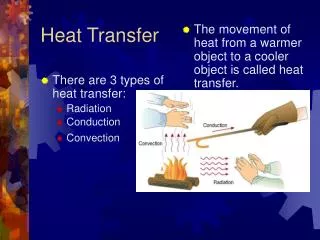
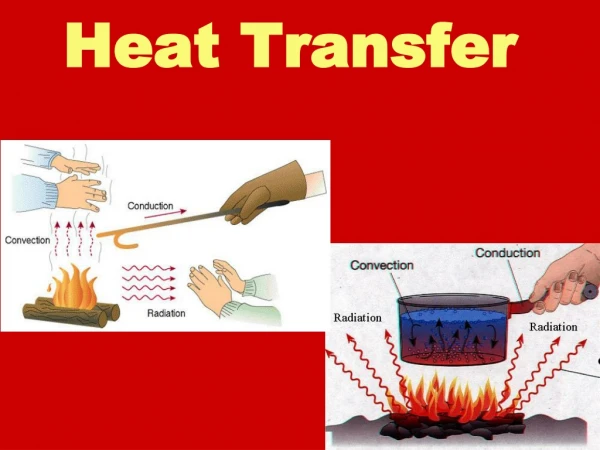
Three Mechanisms • Heat can be transferred from one place to another by • Conduction, • Convection • Radiation.
Bill Nye Video • http://www.youtube.com/watch?v=f1eAOygDP5s&safe=active • 2:06
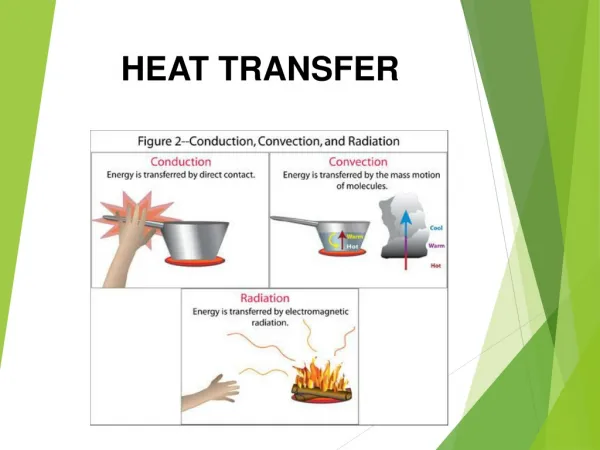
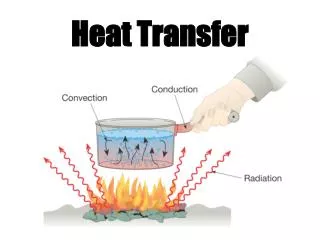
Conduction • Transfers heat by direct contact • Matter touching matter • Can occur between any state of matter: solid, liquid or gas • Metals are good conductors of heat • Bad conductors include wood, rubber, glass • Example: Heat transfers directly from the element of a stove to a metal pot http://www.youtube.com/watch?v=wV7gzcKegdU&safe=active Eureka Conduction 2:02
Convection • Heat is transferred by the moving of particles/molecules from one place to another • Hotter particles move further apart and rise • Cooler particles move closer together and fall • Transfer is therefore vertical (up & down) • Only occurs in liquids and gases • Example: Currents are created • http://www.youtube.com/watch?v=ON2Y3FEk_UI&safe=active Eureka Convection 2:06
Radiation • Transfer of thermal energy by the release of a photon from the Electromagnetic Spectrum • Heat is transferred through space • Electromagnetic (EM) waves from the sun can collide with matter of all types • The EM waves are converted to heat when they collide with matter • Darker and denser objects absorb EM waves faster • http://www.youtube.com/watch?v=2JZciWtK6vc&safe=active Eureka Radiation 4:02
2 1 3
3 2 1
Website for further learning • http://www.wisc-online.com/Objects/ViewObject.aspx?ID=sce304
Heat Transfer Worksheet • Fill in the blanks or label the diagram with one of • Conduction • Convection • Radiation