Advancing Oregon's Climate Solutions: A Vision for Economic Opportunity and Clean Energy
120 likes | 242 Vues
Oregon's approach to climate solutions hinges on practical and profitable strategies that galvanize leadership, grow investments, and bridge divides. With over three decades of climate policy work and successful renewable energy legislation, Oregon is committed to making climate action a top priority. Key measures, including energy efficiency financing and emissions standards, have strengthened environmental planning. Still, challenges remain, including industry uncertainty and the need for a clear roadmap. The state's vision includes continued complementary measures and leveraging stimulus investments to foster a clean energy economy.


Advancing Oregon's Climate Solutions: A Vision for Economic Opportunity and Clean Energy
E N D
Presentation Transcript
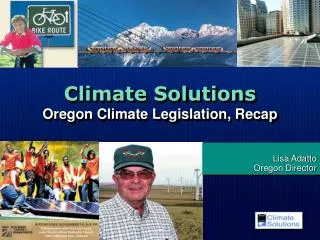
Climate Solutions Oregon Climate Legislation, Recap Lisa Adatto Oregon Director
Climate Solutions • Accelerate practical, profitable solutions by: • Galvanizing leadership • Growing investment • Bridging divides A Rich Vision: Economic opportunity and jobs in the clean energy revolution A practical way to get involved • Business Leaders for Climate Solutions
Context: Climate Policy • Three decades of work on the issue • International agreements • Federal Efforts • Stimulus Bill • Legislation, Waxman Markey, RES, EERS • EPA • An increasing nexus between climate policy and economic development
Background in Oregon • Climate is a top priority area for the Governor • Years of commissions, Western Climate Initiative, workgroups to prepare
Background in Oregon (cont) • Successful session in 2007 devoted to renewable energy legislation • In 2007, state climate goals were adopted, but without an implementation plan or “roadmap” to meet goals • Oregon worked with numerous other states and regions on the Western Climate Initiative to develop a cap and trade system for the region
Where we started in 2009 • 13 Bills • Cap and Trade • Complementary measures
Summary of results • Overall, the “framework” cap and trade bill was not passed • Transportation bill was mixed • Complementary measures have passed: • SB 79 building codes • HB 2186 low carbon fuel standard • (?) SB 101 Emissions performance standard • HB 2626 Financing for energy efficiency • HB 2472 BETC for vehicle manufacturing • Incentives for plug in vehicles • HB 3039 Solar industry incentives
Summary of results (cont) • Potential role backs • BETC funding reduced • Renewable portfolio standard diluted • Transportation bill mixed • Strengthened environmental planning overall • Testing “MPO” planning • Some flex money going to non-road projects • Mostly business as usual
Other Climate Initiatives • Regional initiatives • City-based planning • Private initiatives • NWFPA • NEEA
What are the problems left? • Uncertainty for industry • Lack of alignment about priorities • Lack of integration of carbon and transportation planning • Utilities need new authority and direction • Lack of clear signal to move forward
What do we need now? • Statewide road map • Continue implementing complementary measures to provide new tools • Continue to work on ghg cap
What does the future hold? • Climate issue remains a driver and an opportunity • Stimulus dollars – investment • Next year’s legislation