Absolutists vs. Relativists: The First Amendment Debate Between Hentoff and Bork
Dive into the contrasting perspectives of Nat Hentoff and Robert Bork on the First Amendment. Hentoff, an absolutist, believes any speech restriction violates the amendment's core, while Bork, a relativist, argues it's intended to protect political speech, not obscenity. Explore their views on indecency, the Founding Fathers' intent, and contemporary issues like social value in art. This discussion raises critical questions about censorship, minority rights, and the protection of political ideas versus societal norms.

Absolutists vs. Relativists: The First Amendment Debate Between Hentoff and Bork
E N D
Presentation Transcript
First Amendment Are you an absolutistor a relativist?
Nat Hentoff: Absolutist • Northeastern graduate • Wrote liner notes for John Coltrane and Bob Dylan • First Amendment views formed by getting kicked off the News
Robert Bork: Relativist • Served Richard Nixon • Failed Supreme Court nominee • Blames liberal judges for protecting “vulgarity and obscenity”
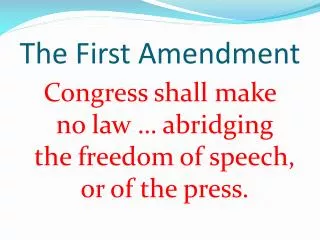
Understanding“make no law” • Hentoff: Any restriction on speech, even libel law, violates the First Amendment • Bork: The First Amendment was meant to protect political speech, not indecency and violence
Hentoff on obscenity • Founders were unconcerned • Supreme Court didn’t mention until 1957 • Brennan, in Roth, introduced social value
Lenny Bruce • A satirist with a dirty mouth • How do you define social value? • Won on appeal, but it was too late
Bork on obscenity • Criticizes Snoop Dogg, Nine Inch Nails • Driven by aesthetic as well as legal judgments • Hentoff may be wrong — Chaplinsky,Near v. Minnesota
Hentoff versus Bork • Protection of political ideas versus threat of censorship • A loophole for censors versus a loophole for pornographers • Minority rights versus majority rule