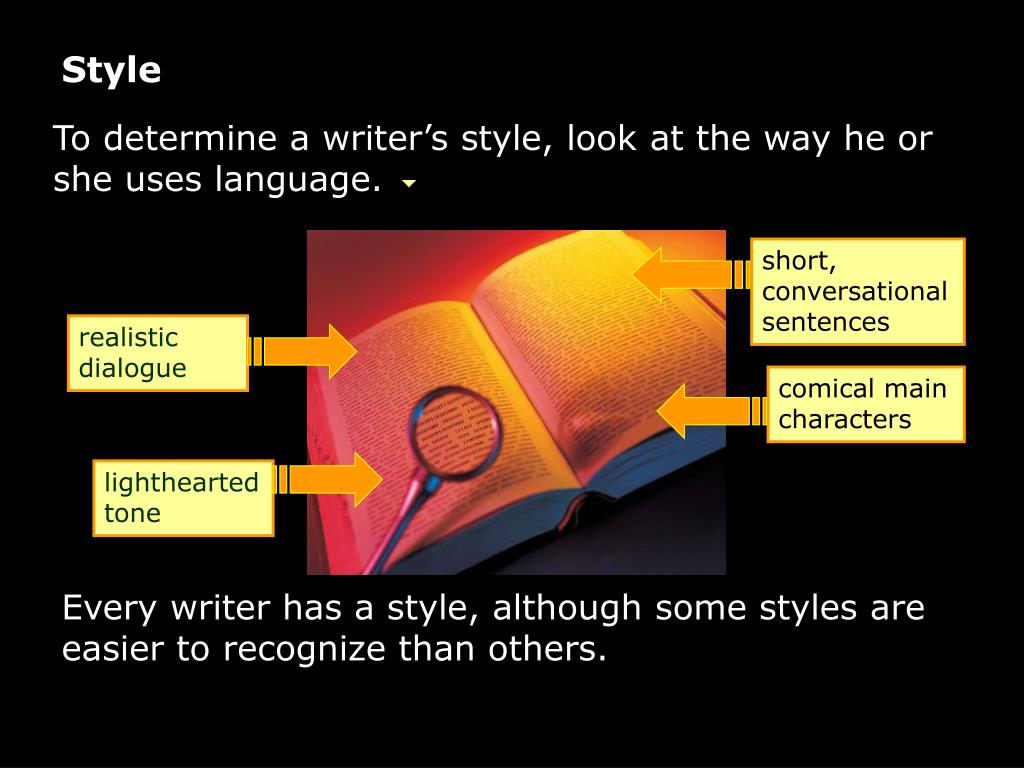
short, conversational sentences realistic dialogue comical main characters lighthearted tone Style To determine a writer’s style, look at the way he or she uses language. Every writer has a style, although some styles are easier to recognize than others.
Figurative Language Writers often use figurative language—language based on some sort of comparison that is not literally true. His eyes sparkled like . . . diamonds. Figurative language can be an important part of a writer’s style.
Figurative Language Here are some figures of speech that you will find in your reading: Metaphors compare unlike things directly, without using a specific word of comparison. Similes compare two unlike things using a word of comparison, such as like, than, as, or resembles. expressions that mean something different from the literal meanings of the words Idioms a reference drawn from literature, popular culture, or current events. allusions
Figurative Language Metaphors Metaphors compare unlike things directly, without using a specific word of comparison. Hannah’s eyes are starsbrightening the room. Change this metaphor into a simile.
Figurative Language Similes Similes compare two unlike objects using a word of comparison, such as like,than, as, or resembles. Youssefshot up like a rocketas he went for the basket. Describe how Youssef made his shot.
Figurative Language Quick Check Identify the similes and metaphor Christian was upset when his mother told him his room smelled like an old running shoe. “How can you say that, Mom?” he asked, his face a question mark. “I’m as neat as a tack.” “Maybe the room is neat, but your laundry bag is overflowing with sweaty clothes,” replied his mom. “I think the bag will walk out of here on its own pretty soon.”
Figurative Language Quick Check Identify the similes, metaphor, and personification. Christian was upset when his mother told him his room smelled like an old running shoe. “How can you say that, Mom?” he asked, his face a question mark. “I’m as neat as a tack.” “Maybe the room is neat, but your laundry bag is overflowing with sweaty clothes,” replied his mom. similes metaphor
Figurative Language Idioms Idioms are expressions that mean something different from the literal meanings of the words. The actor hid nothing from her fans. Her life, you might say, was an open book. How does the idiom express the idea that nothing is hidden?
Figurative Language An allusion is a reference drawn from literature, popular culture, or current events. For example, a writer might say, “He lied so much he had a nose like Pinocchio” or “She was as sweet as Snow White.” In both cases, the writer is making an allusion to a familiar literary character.
Figurative Language The writer assumes that the reader is familiar with an allusion through general knowledge. Even though his name was Joe, his friends called him Honest Abe. Writers use allusions to create comparisons that make characters come to life.
Figurative Meaning versus Literal meaning Figurative meaning is the intended interpretation of the language. Literal meaning is the literal interpretation of the words used Example: Cup of Joe Figurative= a cup of coffee Literal= an actual cup of Joe
Assignment: In pairs look through the story, “Raymond’s Run” and find all of the Similes, Metaphors, idioms, and allusions. Create a Treemap that includes the term, definition, all examples, and the figurative meanings