
SlideServe
Menu
Préférences
© SlideServe · v2026

Doris Network Renovation and Collocations Status Report

chrissolomon avatar
14 diapositives · 169 Views · Jan 03, 2020

This report provides updates on the renovation progress of the Doris network, including the installation of new stations and the collocations with other IERS techniques. It also highlights theoretical and actual collocations with other techniques, as well as tide gauge collocations.
Doris Network Renovation and Collocations Status Report - slide 1
01 / 14Doris Network Renovation and Collocations Status Report
1 / 17

Télécharger la présentation

Doris Network Renovation and Collocations Status Report
Une image / un lien ci-dessous est fourni (tel quel) pour télécharger la présentation

Politique de téléchargement : le contenu du site vous est fourni TEL QUEL pour votre information et votre usage personnel ; il ne peut être vendu, concédé sous licence ni partagé sur d’autres sites sans l’accord de son auteur.Le contenu vous est fourni TEL QUEL, pour votre information et votre usage personnel uniquement. Téléchargez la présentation en cliquant sur ce lien. Lors du téléchargement, si vous ne parvenez pas à télécharger une présentation, l’éditeur a peut-être supprimé le fichier de son serveur.Pendant le téléchargement, si vous ne parvenez pas à obtenir une présentation, le fichier a peut-être été supprimé par l’éditeur.

F I N

Plus de contenu associé

Transcription de la présentation
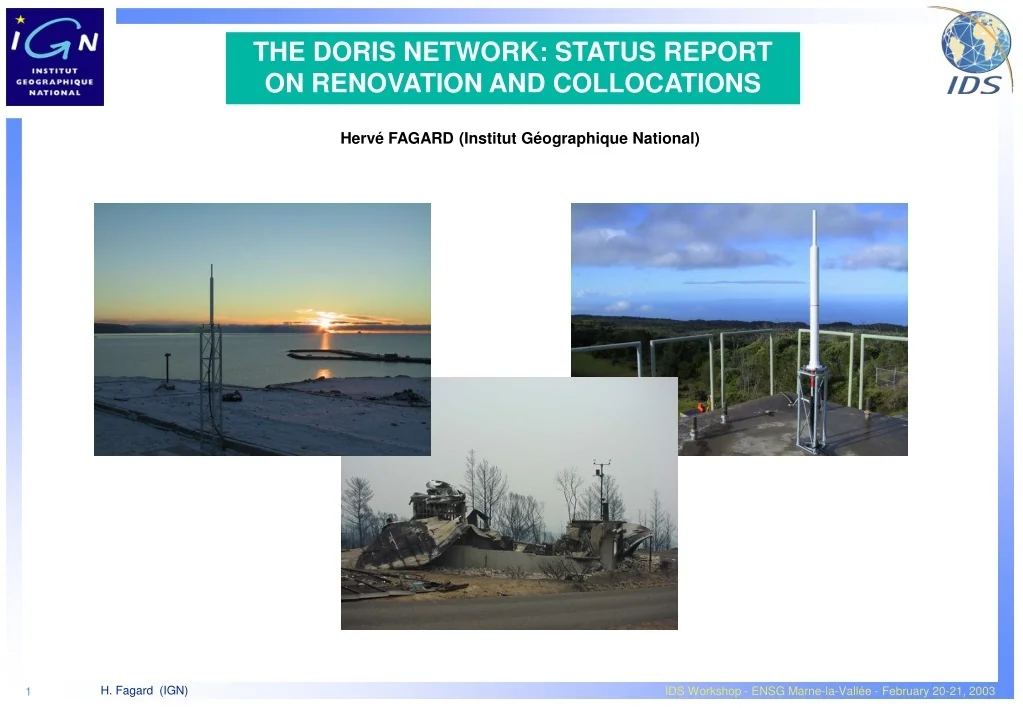
  1. THE DORIS NETWORK: STATUS REPORT ON RENOVATION AND COLLOCATIONS Hervé FAGARD (Institut Géographique National)

  2. The network on 2003/01/01 • 56 stations, 33 countries • Circles: SPOT-n & Envisat, 12°

  3. Distribution of the DORIS equipment Version 1.0 or 1.1 beacon Version 2 beacon Version 3 beacon + + + + + + Alcatel antenna Alcatel antenna Alcatel antenna Starec antenna Starec antenna Starec antenna 9 stations 24 stations 1 station 12 stations 1 station 9 stations

  4. Evolution of the network SPOT-5 ENVISAT JASON SPOT-3 SPOT-4 TOPEX SPOT-2

  5. Network: latest news • Two new stations installed at the end of 2002: • Thule (Greenland) • Sal (Cape Verde), replacing Dakar • Theoretical orbit coverage (when all stations are operating): • “Low” satellites (SPOT-2 , 4, 5 & Envisat) : 88 % • “High” satellites (Topex & Jason): 98 % • Stations renovated in 2002: • Tristan da Cunha, Terre Adélie, Port Moresby, Kauai • Next planned renovations: • Manila (next week) • St Helena, Ascension (March) • Mount Stromlo destroyed by fire in January; should be rebuilt by mid-2003

  6. Network renovation progress

  7. Antennas estimated stability (2002/01/01)

  8. Collocations with other IERS techniques:theoretical vs. actual • Many collocated instruments are not currently operating: • Discontinued long-term occupation by: • VLBI (Richmond, Santiago) • SLR (e.g. Dionysos, Easter Island, Goldstone, etc.) • Short duration (2 days only once, to a few days per year) mobile VLBI occupation (Toulouse, Ponta Delgada, Metsähovi, Greenbelt) • Unreliable tie: • Insufficient accuracy, measured only once, sometimes many years ago • Very long baseline, different geological movements (e.g. Kourou) • Network future evolutions should aim at adding a few VLBI and SLR collocations

  9. Theoretical/actual number of collocations

  10. Theoreticalcollocations with other IERS techniques

  11. Actualcollocations with other IERS techniques

  12. DORIS-DORIS collocations (1) • 29 DORIS stations have multiple antenna positions: • Two different antenna positions at 21 sites • Three different antenna positions at 8 sites • All ties between different antenna positions on the same site have been measured accurately, except: • AMSA-AMSB (approximate connection planned, AMSA no longer exists) • HBKA-HBLA (antenna moved by host agency, no direct survey) • HELA-HELB (antenna change by host agency, no survey) • KERA-KERB (dubious KERA antenna height) • GOLA-GOMA (no direct connection)

  13. DORIS-DORIS collocations (2)

  14. Tide gauges collocations (<10 km)