
SlideServe
Menu
Préférences
© SlideServe · v2026

Phase Transformations in Materials

christophercarroll avatar
22 diapositives · 449 Views · Jan 03, 2020

Explore the effects of time and temperature on phase transformations in materials, including mechanical property changes. Learn about different classes of transformations and their impacts on structures. Dive into nucleation, growth, and microstructural development processes. Understand non-equilibrium transformation products like bainite, spheroidite, and martensite. Discover isothermal and continuous cooling transformation diagrams. Gain insights on mechanical properties and processing options.
Phase Transformations in Materials - slide 1
01 / 22Phase Transformations in Materials
1 / 17

Télécharger la présentation

Phase Transformations in Materials
Une image / un lien ci-dessous est fourni (tel quel) pour télécharger la présentation

Politique de téléchargement : le contenu du site vous est fourni TEL QUEL pour votre information et votre usage personnel ; il ne peut être vendu, concédé sous licence ni partagé sur d’autres sites sans l’accord de son auteur.Le contenu vous est fourni TEL QUEL, pour votre information et votre usage personnel uniquement. Téléchargez la présentation en cliquant sur ce lien. Lors du téléchargement, si vous ne parvenez pas à télécharger une présentation, l’éditeur a peut-être supprimé le fichier de son serveur.Pendant le téléchargement, si vous ne parvenez pas à obtenir une présentation, le fichier a peut-être été supprimé par l’éditeur.

F I N

Plus de contenu associé

Transcription de la présentation
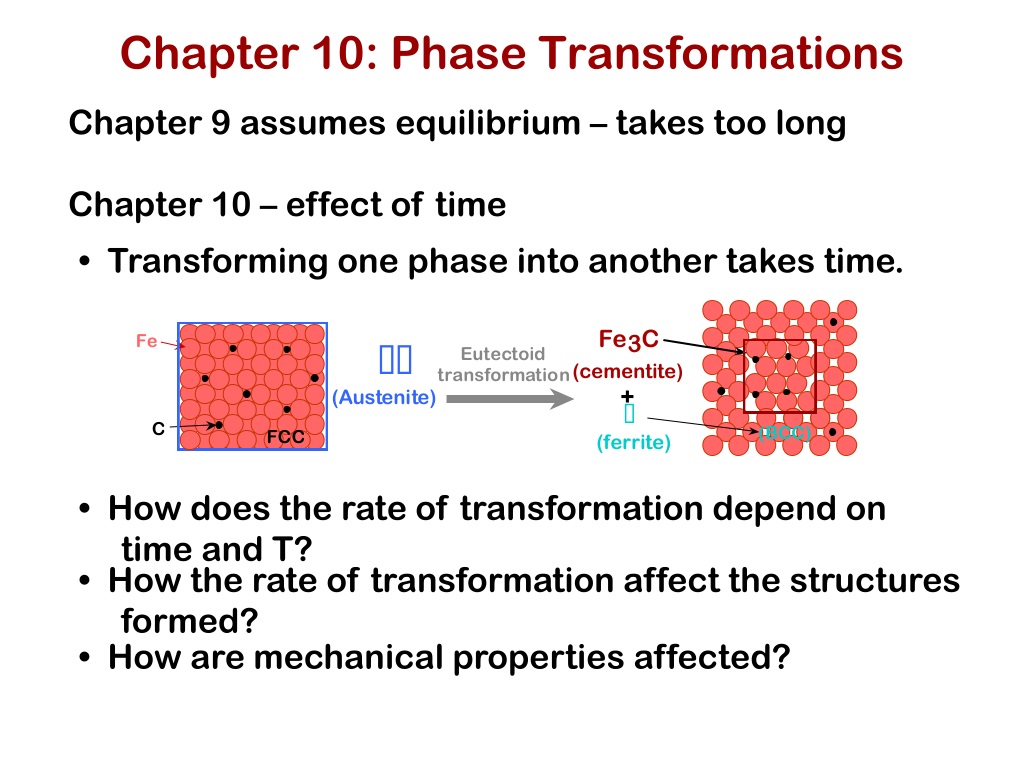
  1. Chapter 10: Phase Transformations Chapter 9 assumes equilibrium – takes too long Chapter 10 – effect of time • Transforming one phase into another takes time. • How does the rate of transformation depend on time and T? • How the rate of transformation affect the structures formed? • How are mechanical properties affected?

  2. Chapter 10: Phase Transformations Classes: 1. Simple diffusion-dependent transformation: no change in the number or composition of phases 2. Diffusion-dependent with changes in compositions and/or number of phases (e.g., eutectic reaction) 3. Diffusionless transformation – produces metastable phase • Impediments to PT: • Time-dependent diffusion, • Phase boundary energy • Processes: • Nucleation, • Grain growth

  3. FRACTION OF TRANSFORMATION • Fraction transformed depends on time. • Transformation rate depends on T. • Problems with phase diagrams; - rates not shown - equilibrium cooling is too slow  supercooling  transformation occurs at a lower temperature

  4. Super Cooling and Eutectoid Transformation Rate • Growth of pearlite from austenite: • Reaction rate increases with DT.

  5. NUCLEATION AND GROWTH • Reaction rate is a result of nucleation and growth of crystals. • Examples:

  6. ISOTHERMAL COOLING • Quickly cool to below TE and keep at constant temp • Fe-C system, Co = 0.77wt%C • Transformation at T = 675C.

  7. Microstructural Development: Example • Eutectoid composition, Co = 0.77wt%C • Begin at T > 727C • Rapidly cool to 625C and hold isothermally.

  8. Isothermal Transformation Diagrams or TTT (time-temp-transformation) plots • Above TE only • For 540<T<726C, • two solid lines: • - left of first line -  only • - right of 2nd line – P only • - rate controlled by nucleation • - Coarse vs. fine pearlite: • - high temp: coarse P (faster diffusion  thicker layers) • - low temp: fine pearlite • Below 540C • - Bainite formation • - rate is diffusion controlled • Below 215C - Martensite

  9. Coarse vs. Fine Pearlite Two cases: • Ttransf just below TE --Larger T: diffusion is faster --Pearlite is coarser. • Ttransf well below TE --Smaller T: diffusion is slower --Pearlite is finer.

  10. NON-EQUIL TRANSFORMATION PRODUCTS: Fe-C • Bainite: - elongated Fe3C particles in a continuous a matrix - diffusion controlled

  11. Spheroidite • spherelike particles of Fe3C in a continuous ferrite matrix • heating pearlite or bainite to below 726 for a long time (e.g., 700C for 18-24 hours) • Additional diffusion: reduction in surface boundary

  12. Martensite • Martensite: - metastable phase - polymorphic: g(FCC) to Martensite (BCT) • Isothermal Transf. Diagram • g to M transformation - diffusionless - rapid - athermal (independent of time).

  13. Isothermal Cooling: Examples

  14. Isothermal Cooling: Example

  15. Isothermal Cooling:

  16. Continuous Cooling Transformation (CCT) diagrams • delayed start and end • results depend on cooling rate • - moderately rapid – fine P • - slow – coarse pearlite • no bainite formation

  17. Continuous Cooling • three regions: pure martensite, M+P, pure P • critical cooling rate – minimum rate that produces totally martensitic structure

  18. Mechanical Properties • presence of other allowing elements – (e.g., Cr, Ni, Mo, and W) – delay pearlite formation  stronger • other %C compositions – proeutectoid phase

  19. Mechanical Properties

  20. Mechanical Properties • Fine Pearlite vs Martensite: • Hardness: fine pearlite << martensite.

  21. Tempered Martensite • • heat martensitic steel below eutectoid (250-650C) • martensite (BCT - supersaturated)  stable  and Fe3C • similar to spheroidite but smaller cementite particles. • reduces brittleness of martensite.

  22. SUMMARY: PROCESSING OPTIONS