Understanding Gas Behavior and the Ideal Gas Law
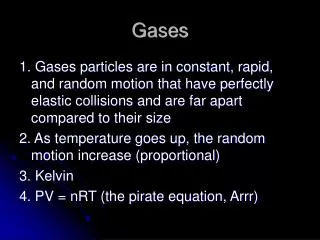
Gases consist of particles in constant, rapid, and random motion, experiencing perfectly elastic collisions and significant distances relative to their size. As temperature increases, the random motion of gas particles increases proportionally. The Ideal Gas Law, expressed as PV = nRT, relates pressure (P), volume (V), the number of moles (n), and temperature (T in Kelvin). To solve for any variable, organize the values alphabetically, ensuring T is in Kelvin and using a question mark for the unknown. This method also allows you to determine the relative number of liters of each gas.

Understanding Gas Behavior and the Ideal Gas Law
E N D
Presentation Transcript
Gases 1. Gases particles are in constant, rapid, and random motion that have perfectly elastic collisions and are far apart compared to their size 2. As temperature goes up, the random motion increase (proportional) 3. Kelvin 4. PV = nRT (the pirate equation, Arrr)
6. You plug each value into its corresponding spot, making sure that PTV are in alphabetical order, T is in Kelvin, and a question mark goes where the missing variable is. Make two V’s connecting three boxes each. The #s the V is connecting to the ? go on the bottom, other #s go on top 7. They equal the relative number of liters of each gas