Understanding Culture: Geert Hofstede's Dimensions of Cultural Variability
Culture is a complex system of information and values that distinguishes human societies. Geert Hofstede's dimensions of cultural variability explore how cultures differ across key areas: Individualism vs. Collectivism, Power Distance, Uncertainty Avoidance, Masculinity vs. Femininity, and Long-Term Orientation. These dimensions reveal how societal values shape behaviors and attitudes, providing insight into the dynamics of power, gender roles, and the acceptance of uncertainty in various cultures. Understanding these dimensions is crucial for navigating intercultural interactions.

Understanding Culture: Geert Hofstede's Dimensions of Cultural Variability
E N D
Presentation Transcript
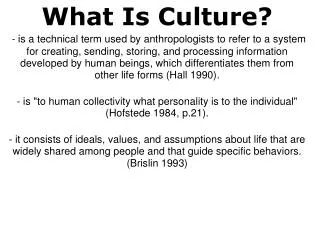
What Is Culture? - is a technical term used by anthropologists to refer to a system for creating, sending, storing, and processing information developed by human beings, which differentiates them from other life forms (Hall 1990). - is "to human collectivity what personality is to the individual" (Hofstede 1984, p.21). - it consists of ideals, values, and assumptions about life that are widely shared among people and that guide specific behaviors. (Brislin 1993)
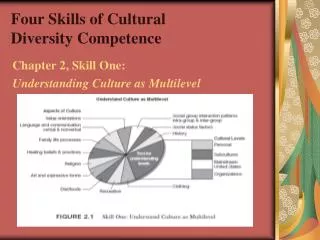
GEERT HOFSTEDE’SDIMENSIONS OF CULTURAL VARIABILITY Individualism-Collectivism Power Distance Uncertainty Avoidance Masculinity-Femininity Confucian Dynamism / Long Term Orientation
Power Distance • Power Distance Index (PDI) that is the extent to which the less powerful members of organizations and institutions (like the family) accept and expect that power is distributed unequally. • This represents inequality (more versus less), but defined from below, not from above. • It suggests that a society's level of inequality is endorsed by the followers as much as by the leaders. • 'all societies are unequal, but some are more unequal than others'
Masculinity-Femininity • refers to the distribution of roles between the genders which is another fundamental issue for any society to which a range of solutions are found. • The IBM studies revealed that (a) women's values differ less among societies than men's values; (b) men's values from one country to another contain a dimension from very assertive and competitive and maximally different from women's values on the one side, to modest and caring and similar to women's values on the other. • The assertive pole has been called 'masculine' and the modest, caring pole 'feminine'. The women in feminine countries have the same modest, caring values as the men; in the masculine countries they are somewhat assertive and competitive, but not as much as the men
Individualism-Collectivism • Individualism (IDV) on the one side versus its opposite, collectivism, that is the degree to which individuals are integrated into groups. • On the individualist side we find societies in which the ties between individuals are loose: everyone is expected to look after him/herself and his/her immediate family. • On the collectivist side, we find societies in which people from birth onwards are integrated into strong, cohesive in-groups, often extended families (with uncles, aunts and grandparents) which continue protecting them in exchange for unquestioning loyalty.
Uncertainty Avoidance • a society's tolerance for uncertainty and ambiguity. It indicates to what extent a culture programs its members to feel either uncomfortable or comfortable in unstructured situations. Unstructured situations are novel, unknown, surprising, different from usual. • Uncertainty avoiding cultures try to minimize the possibility of such situations by strict laws and rules, safety and security measures, and on the philosophical and religious level by a belief in absolute Truth; • People in uncertainty avoiding countries are also more emotional, and motivated by inner nervous energy. • The opposite type, uncertainty accepting cultures, are more tolerant of opinions different from what they are used to; they try to have as few rules as possible, and on the philosophical and religious level they are relativist and allow many currents to flow side by side. • People within these cultures are more phlegmatic and contemplative, and not expected by their environment to express emotions.
Confucian Dynamism / Long Term Orientation • this fifth dimension was found in a study among students in 23 countries around the world, using a questionnaire designed by Chinese scholars • It can be said to deal with Virtue regardless of Truth. • Values associated with Long Term Orientation are thrift and perseverance; values associated with Short Term Orientation are respect for tradition, fulfilling social obligations, and protecting one's 'face'. • Both the positively and the negatively rated values of this dimension are found in the teachings of Confucius, the most influential Chinese philosopher who lived around 500 B.C.; however, the dimension also applies to countries without a Confucian heritage.