Download
1 / 12
120 likes | 226 Vues
This analysis explores the multifaceted factors impacting food demand, particularly focusing on age structure within populations. Developing countries typically exhibit higher percentages of young individuals, while developed nations show more even age distributions. Changes in age structure, such as a baby boom, can significantly affect population growth for decades. Additionally, factors like dependency ratios, the number of pregnant women, physical activity levels, and dietary habits—including the increasing demand for meat—further influence future calorie needs and overall food supply requirements.

E N D
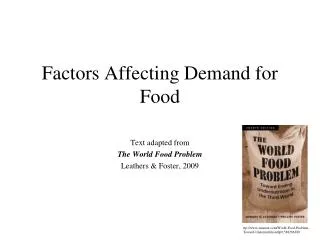
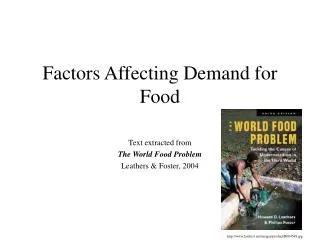
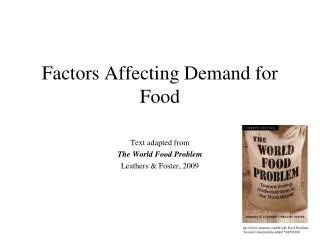
Factors Affecting Demand for Food Text adapted from The World Food Problem Leathers & Foster, 2009 ttp://www.amazon.com/World-Food-Problem-Toward-Undernutrition/dp/1588266389
Age Structure • Population Pyramids • indicate age structure • Developing countries • have much higher percentage of young people • Developed countries • have even distribution of age groups http://www.scalloway.org.uk/images/poppy1.jpg http://www.scalloway.org.uk/images/poppy2.jpg
Momentum • Changes in age structure affect population for decades • Example: Baby Boom • If a developing country achieves replacement fertility rates for adults • Population growth continues for decades • Because there are more children Baby boom age pyramid
Age structure for China (1990) Great Leap Forward Famine, 1959-1960 http://www.iiasa.ac.at/Research/LUC/ChinaFood/images/charts/p_19a_m.gif
Dependency Ratios • Ratio of dependents to working adults • Burden of dependent children per adult greater in developing country • Developed nation ex: • 0.21 children/adult • Developing nation ex: • .77 chlidren/adult http://www.scalloway.org.uk/images/poppy1.jpg
Age Structure determines future calorie needs • Calorie needs are different at different ages • Age structure allows prediction of future calorie needs • as current population grows up • Need for food can grow faster than the population • if more adults than children • Adults require more food http://www.scalloway.org.uk/images/poppy2.jpg
Other factors affecting future food needs • Number of Pregnant women • Amount of physical activity • Height of population • indicates nutrition level • Population + demand/person + more meat • Huge synergistic effect Sierra Leone 8 year old girl
More Meat • As incomes rise, people eat more meat • less cereals • Meat production requires plant calories • Average 6:1 conversion ratio • Developing countries eat 4,224 Calories from plants • 2,255 directly from plants • Plus 315 meat calories (12.5%) • Requires 1,969 plant calories to produce meat http://images.jupiterimages.com/common/detail/20/63/23036320.jpg
More Meat • If people in developing countries ate 15% meat • Would increase total plant calories required • to 4,591/person • Equivalent increase in demand to 8.7% increase in population http://delishfood.files.wordpress.com/2007/10/img_4381.JPG
More Meat • If people in developing nations ate amount of meat eaten in developed nations (27% calories) • Would require 6,200 plant-derived calories • 47% increase http://i157.photobucket.com/albums/t49/cinzia326/7025.jpg
Optimistic Future Scenario: Next 50 yrs • Per capita income increases • Population growth of 50% • Fertility declines • Food supplies keep pace with demand • Life expectancy increases • Average height increases • Age structure changes toward fewer children • Food demand grows by 101% Morocco: middle income country
Same impact if pessimistic future • Self-Correction on impact with lower quality of life: • If prosperity declines • Food supply doesn’t keep up with demand • Population grows more rapidly • Less decline in fertility rates • But need less food because • Age structure: more children • Average height: less change • Calories per capita low • Undernutrition • Dietary diversification small • Impact: 98% growth in food demand Sierra Leone mother http://www.voices-unabridged.org/photo_gala/gala_dec_2006_pt_18.jpg