Understanding Sensation: Absolute and Difference Thresholds in Psychophysics
Explore the concepts of sensation and the detection of stimuli in psychophysics. This overview covers the absolute threshold, defined as the minimum stimulus magnitude detectable 50% of the time, and the difference threshold, which indicates the smallest change needed for detection. Learn about Weber's Law and the Weber Fraction, highlighting the relationship between physical stimulus intensity and psychological perception. Gain insights into how we perceive changes in sensation, supported by historical figures like E.H. Weber and Gustav Fechner.

Understanding Sensation: Absolute and Difference Thresholds in Psychophysics
E N D
Presentation Transcript
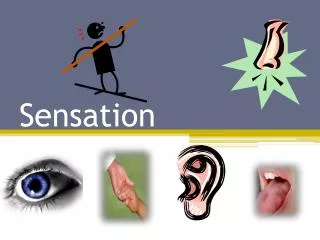
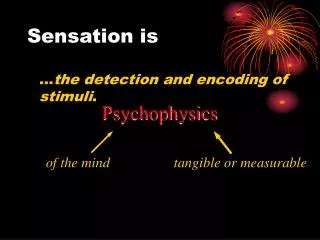
Sensation is …the detection and encoding of stimuli. Psychophysics of the mind tangible or measurable
Absolute threshold: …the minimum magnitude of stimulus that can be detected 50% of the time.
The Ideal Threshold (does not exist in nature)
Difference threshold: …the minimum amount a stimulus must change in order for the change in sensation to be detected 50% of the time. the jnd
How well do you understand the statement: “The absolute threshold is really just a special type of a difference threshold.” • I understand. • I do not understand. • I will have to think about it more.
In the 1830s, E.H. Weber Weber Fraction = the amount of stimulation necessary to result in a “just noticeable difference” is a constant fraction of the stimulus intensity e.g., for weight: k = 1/50 (the Weber Fraction) 1 lb. = 2 lb. = 1/5 lb. 50lb. 100 lb. 10 lb. The Weber Fraction varies with sensory modality.
Gustav Fechner (1801 – 1887) jnds are units of psychological changes in sensation proposed a law describing the relationship between psychological and physical events: S = k log I Psychological Weber Physical (units: jnds) Fraction (units: lbs., dB, etc.)