Resting Membrane Potential
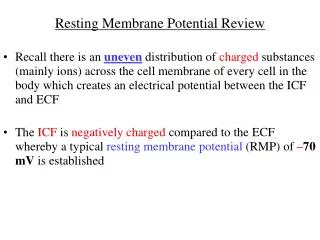
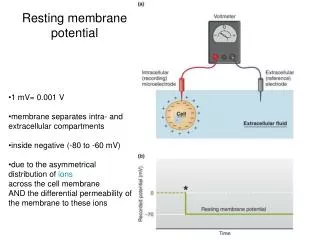
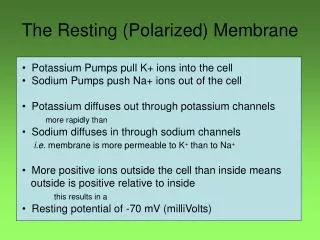
The resting membrane potential is typically around -70mV, reflecting a more negative charge inside the cell. This potential is primarily influenced by the relative concentrations of ions such as Na+, K+, and Cl-. K+ efflux through leaky channels plays a key role in establishing this negative charge. The ATPase pump helps maintain this potential by moving two K+ ions into the cell while expelling three Na+ ions, counteracting Na+ leakage. Any deviation from this potential triggers cellular impulses, showcasing the dynamic balance of ions across the membrane.


Resting Membrane Potential
E N D
Presentation Transcript
Resting Membrane Potential Whitney Theis March 31, 2006
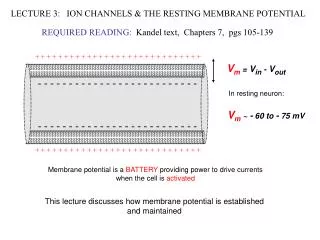
Charge of a Cell • Normally a cell is more negative on the inside • On average -70mV • The negative charge forms a thin layer along the inside of the membrane
Major Players in Resting Potential • Na+, K+, and Cl- • The resting potential due to the efflux of K+ out of the cell • Leaky channels • Relative concentrations
Development of Resting Potential • Cell thrown out of resting potential when impulse occurs across membrane • When this happens the ATPase pump offsets the action • There are K and Na channels that are always open • K flows out faster than Na
ATPase Pump • Allows two potassium ions in and three sodium ions out • This pump offsets the slow leak of Na+ into the cell • The leaky potassium channels are not offset by the pump • Thus membrane potential due to eflux of potassium