Understanding Active and Passive Voice: Key Differences and Examples
This guide explores the differences between active and passive voice, showcasing how the subject plays distinct roles in sentences. In active voice, the subject performs the action (e.g., "John amused Mary"), while in passive voice, the subject receives the action (e.g., "Mary was amused by John"). We provide examples and activities, including identifying voice types and converting passive sentences to active forms. Enhance your writing skills by mastering these essential grammatical concepts.

Understanding Active and Passive Voice: Key Differences and Examples
E N D
Presentation Transcript
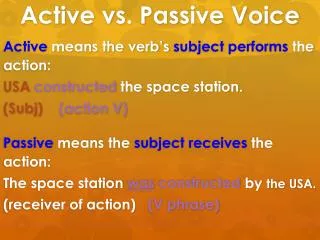
Active Voice The subject is either the “do-er” of the action verb or the subject of the linking verb. John amused Mary.
Passive Voice The subject is the “recipient” of the action of the verb. Mary was amused (by John).
Examples Passive: My car was made in Japan Active: Somebody made my car in Japan. The announcement is expected at any moment. Everybody expected the announcement at any moment. Bugsy was acquitted by the Jury. The jury acquitted Bugsy.
Determine which sentences below are passive versus active voice. • The book was reviewed by the whole committee. • They confined him to his quarters. • Bugsy’s sentence was commuted by the Governor. • The movie really scared the children • The painting was greatly admired.
Convert the passive voice sentences below to active voice. • The opening was concealed by a wooden screen. • Large debts were incurred by my client. • Attila the Hun was criticized by the social committee. • The first question was missed by everyone. • The movie was based on the play.