Enhancing Cultural Competence in Libraries: Understanding Diversity and Identity
210 likes | 310 Vues
This text explores the essential role of cultural competence in library services, emphasizing the importance of recognizing and respecting diverse belief systems and value orientations that shape customs, norms, and practices. It discusses identity, both individual and collective, and introduces concepts of high-context and low-context cultures. Acknowledging that effective services must align with user needs, it highlights strategies for librarians to work effectively across cultures and create inclusive information environments. The framework includes cognitive, interpersonal, and environmental domains, supporting the development of culturally competent professionals in library and information science.


Enhancing Cultural Competence in Libraries: Understanding Diversity and Identity
E N D
Presentation Transcript
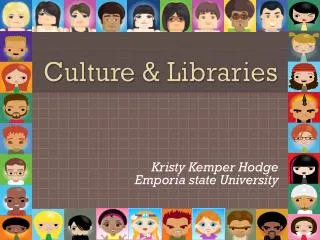
Culture & Libraries Kristy Kemper Hodge Emporia state University
Culture is… “Belief systems & value orientations that influence customs, norms, practices, and social institutions” - APA Guidelines
Related Terms Race Ethnicity Multiculturalism and Diversity
Cultural Characteristics • Identity: • Individual • Collective • Context: • High context • Low context
So What? • “For any service to be effective, it must relate to the needs and expectations of those who use it.” • Wilson (2000)
Cultural Competence • The ability to… • Recognize one’s own culture • Respect diverse cultures • Work effectively in cross-cultural situations • Customize services based on cultural understanding • Overall (2009)
Cultural Psychology • Traditional Model • General and Cross-Cultural Psychology • Cultural Psychology Model • Overall (2009)
Culturally Competent Librarians • Library & Information Science Model • Cognitive Domain • Interpersonal Domain • Environmental Domain • Overall (2009)
Cognitive Domain • Actions exemplify how people: • Make meaning • Think • Reflect and • Feel about the world • Overall (2009)
Cognitive Domain, cont’d • Cultural Self-Awareness • Building Cultural Knowledge • Overall (2009)
Activity Who Am I Worksheet
Interpersonal Domain • How people: • Behave toward one another • Communicate within social contexts • Overall (2009)
Interpersonal Domain, cont’d • Building Cultural Appreciation • Ethic of Caring • Personal Cultural Interaction • Reflecting on Values • Overall (2009)
Environmental Domain • Elements of: • Surroundings • Conditions and • Settings in which people live • Overall (2009)
Environmental Domain,cont’d • Environmental Barriers • Information Environment • Library Atmosphere • Overall (2009)
Intercultural Leadership • Intercultural Leader Qualities • Knowledge • Vision • Successful relationships • Allard, Mehra, Qayyum (2007)
Intercultural Leader • Abilities: • Reflection • Expansion • Promotion • Allocation • Partnership • Assessment • Allard, Mehra, Qayyum (2007)
Intercultural Leaders “Consider all forms of diversity based on race, ethnicity, gender, sex, sexual orientation, age, disabilities, income, geography, skills, religion, national origins…
…while evaluating the library as a place to represent the needs of all kinds of people.” - Allard, Mehra, Qayyum (2007)
Discussion Who am I and what do I bring to the library and information sciences?
References Allard, Suzie, Mehra, Bharat, Qayyum, M. Asim. (2007). Intercultural Leadership Toolkit for Librarians: Building Awareness to Effectively Serve Diverse Multicultural Populations. Education Libraries, 30(1), 5-12. Overall, Patricia Montiel. (2009). Cultural Competence: A Conceptual Framework for Library and Information Science Professionals. The Library Quarterly, 79, 175-204. Rios-Balderrama, Sandra. (2006). The Role of Cultural Competence in Creating a New Mainstream. Colorado Libraries, 32(4), 3-8. Wilson, Myoung C. (2000). Evolution or Entropy? Changing Reference/User Culture and the Future of Reference Librarians. Reference and User Services Quarterly, 39(4), 387-390.