Download
1 / 14
140 likes | 301 Vues
Invasive species like the Round Goby, Sea Lamprey, and Zebra Mussels pose a significant threat to Michigan's freshwater ecosystems. These non-native organisms disrupt local fish populations, degrade habitats, and outcompete native species for resources. Michigan is home to diverse aquatic life, including salmon and native fish species, but ecological balance is rapidly declining. This guide explores the importance of freshwater habitats, the threats posed by invasive species, and the need for conservation efforts to preserve Michigan's aquatic biodiversity.

E N D
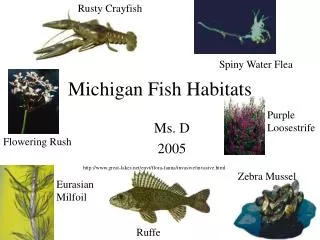
Rusty Crayfish Michigan Fish Habitats Spiny Water Flea Purple Loosestrife Ms. D 2005 Flowering Rush http://www.great-lakes.net/envt/flora-fauna/invasive/invasive.html Zebra Mussel Eurasian Milfoil Ruffe
Why are freshwater habitats Important? • All living things need water • Very diverse in species • Declining rapidly • Recreation • More species rely on coast lines than deep water
Invasive Species • What are they? any species, including its seeds, eggs, spores, or other biological material capable of propagating that species, that is not native to that ecosystem; and whose introduction does or is likely to cause economic or environmental harm or harm to human health.
Invasive Species • Round Goby – from Eurasia in Ballast H2O, they take over prime spawning sites & change habitat • Sea Lamprey - predaceous, eel-like fish native to Atlantic Ocean. Came through the Welland Canal. Cause decline of whitefish and lake trout. • White Perch – from Atlantic coast came through, Erie and Welland canals. Prolific competitors cause declines of walleye populations. • Common Carp - from Caspian Sea region and east Asia. degrade shallow (by turbidity) leading to declines in waterfowl and native fish
Invasive Activity • You will need: • A invasive species card • Answer the following questions: • Who is it? • Describe your species and their environment • How & and when did they get here? • What damage does it inflict?
Salmon in Michigan • Coho or Silver and King or Chinook • Continuous planting for fisherman • Found in all five lakes, pressuring the “Alewives” population • Return to their release site when 3-5 yrs old to spawn and die • Are they invasive?
Spawning • Alevin – when egg hatches, comes out of gravel when entire yolk sac is used up • Fry – hides on edge of stream • Fingerling – length of finger • Smolt – loses spots, begins downstream journey • Adult – head to ocean (lake) where more food • Spawner – returns to river it was born, does not eat, uses all energy to battle way upstream
Native Michigan Fish • Longnose Gar • Burbot • Yellow Perch • Brook Trout • Lake Herring • Northern Pike • Lake Whitefish • Lake Sturgeon
146 types of Fish in Michigan waterways • HABITAT; The area or environment where an organism or ecological community normally lives or occurs • Cold water dwellers (35-65) • Fresh Water • Clean Water (pollution indicators) • Other indicators include insects and larva
Pollution Indicator Activity • Ice cube tray • Spoon • Bucket • Vials • Alcohol • Worksheet
Koi Spawning • Should be two males to one female • Males sandwich female to release eggs • Males simultaneously release milt which fertilizes most eggs as they are released • The eggs are very sticky and remain wherever they land • If parents are left in spawning environment they will eat all the eggs
Egg Removal • Parents must be removed • Water drained • Eggs removed gently with a paint brush tool • Eggs must then be placed into a small tank with a bubbler and thermometer
Koi • Eggs hatch in 24hrs • Should be around 75 degrees • In the first day they need to be fed “boiled egg yolk” and then crushed koi food • To reduce a vitamin C deficiency give pieces of DARK green lettuce • Ph of 7 is preferred, ph difference correlates to fry color