Performance Evaluation of JXTA in Peer-to-Peer Data Sharing: Insights and Results
This presentation by David A. Noblet from the University of New Hampshire discusses the performance evaluation of JXTA, a peer-to-peer data sharing protocol utilized in the JuxMem project. The presentation covers various aspects of daily life in Rennes, France, where the research is conducted, including cultural differences and social environments. It delves into the client-server and peer-to-peer models, highlighting JXTA's architecture, performance concerns, testing methodologies, and key results. The findings indicate that JXTA performs adequately over a Fast Ethernet connection, allowing for large file transfers but introduces some overhead and responsiveness challenges.

Performance Evaluation of JXTA in Peer-to-Peer Data Sharing: Insights and Results
E N D
Presentation Transcript
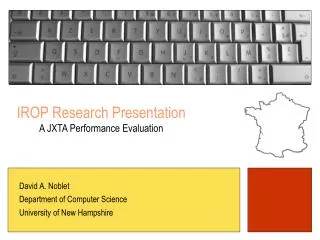
IROP Research Presentation A JXTA Performance Evaluation David A. Noblet Department of Computer Science University of New Hampshire
2 Rennes, France • Population: 195,000 • Capital of Brétagne • Famous for… • Half-timbered houses • Cobblestone roads • Crêpes • Home of… • University of Rennes • IRISA Lab
3 La vie quotidienne (Daily Life) • Almost everything is similar • Almost nothing is the same • Some important differences: • Stores close early • Transportation is punctual • What commercials? • There are no change machines!
4 Work Hard. Break Hard. • Work as a social environment • Togetherness • Lunch • “Café (Coffee)?” • Busy evenings • Late mornings
5 My Research • IRISA Lab • PARIS Team • JuxMem Project • Peer-to-peer data sharing service • Enables groups of computers to dynamically organize into a virtual data storage unit • Could potentially allow research organizations to easily share common data • Performance concerns
6 Computer Networks • Communication groups • Directed graph representation • Network services • Typical examples • Websites • Email • Instant messaging
7 The Client-Server Model • Two different roles • Client • Server • Traditional • Web browser - Web server • Email client - Email server • Simple • Problems • Scalability • Fault tolerance
8 The Peer-to-Peer Model • One role -- The Peer • Both requests and provides service • More recent • Examples • Music sharing • Gnutella • WinMX • Advantages • Scales well • Not centrally dependent • Problems • Extra Complexity --> Overhead
9 JXTA (http://www.jxta.org) • Provides • Set of XML-based peer-to-peer protocols • Application framework to use the protocols • Solves common peer-to-peer problems • Runs under Java (though there are others) • Used by JuxMem • Common perceptions • Java is slow • XML is bulky • Peer-to-peer services = lots of overhead
10 Testing Performance • JXTA = Peer-to-peer + XML + Java = Bad performance? • Maybe • It is a concern • Performance metrics • Bandwidth (speed) • Latency (responsiveness) • How to find out • Test! • Round Trip Time (RTT) acknowledgement message
11 Some Results (1 of 3)
12 Some Results (2 of 3)
13 Some Results (3 of 3)
14 Conclusions • JXTA doesn’t perform too poorly • Can basically saturate a Fast-Ethernet (100 Mb/s) connection • Would be good for things like large file transfers • It does introduce overhead • Not incredibly responsive • Has trouble keeping up with Myrinet