SlideServe
Menu
Préférences
© SlideServe · v2026

Electrode Potentials

cleo-finch avatar
30 diapositives · 1.4K Views · Nov 29, 2014

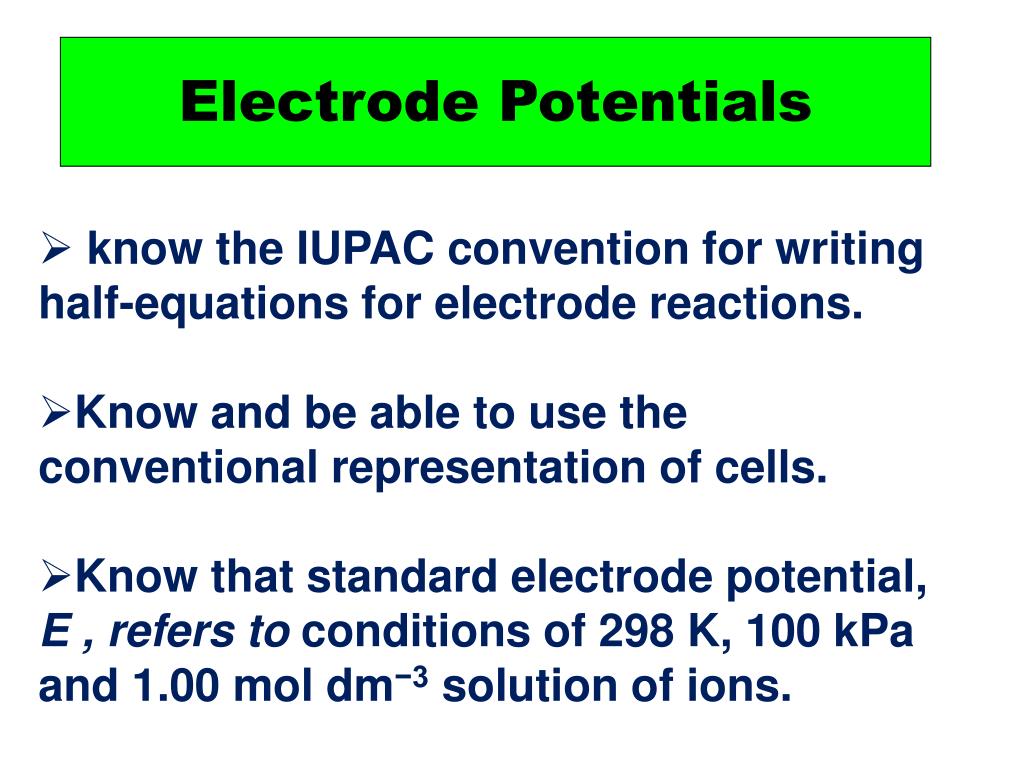
Electrode Potentials. know the IUPAC convention for writing half-equations for electrode reactions. Know and be able to use the conventional representation of cells. Know that standard electrode potential, E , refers to conditions of 298 K, 100 kPa and 1.00 mol dm −3 solution of ions.
Electrode Potentials - slide 1
01 / 30Electrode Potentials
1 / 17

Télécharger la présentation

Electrode Potentials
Une image / un lien ci-dessous est fourni (tel quel) pour télécharger la présentation

Politique de téléchargement : le contenu du site vous est fourni TEL QUEL pour votre information et votre usage personnel ; il ne peut être vendu, concédé sous licence ni partagé sur d’autres sites sans l’accord de son auteur.Le contenu vous est fourni TEL QUEL, pour votre information et votre usage personnel uniquement. Téléchargez la présentation en cliquant sur ce lien. Lors du téléchargement, si vous ne parvenez pas à télécharger une présentation, l’éditeur a peut-être supprimé le fichier de son serveur.Pendant le téléchargement, si vous ne parvenez pas à obtenir une présentation, le fichier a peut-être été supprimé par l’éditeur.

F I N

Plus de contenu associé

Transcription de la présentation
  1. Electrode Potentials • know the IUPAC convention for writing half-equations for electrode reactions. • Know and be able to use the conventional representation of cells. • Know that standard electrode potential, E , refers to conditions of 298 K, 100 kPa and 1.00 mol dm−3 solution of ions.

  2. Zn2+(aq) + 2 e–  Zn(s)

  3. - electrode anode oxidation + electrode cathode reduction electron flow At this electrode the metal loses electrons and so is oxidised to metal ions. These electrons make the electrode negative. At this electrode the metal ions gain electrons and so is reduced to metal atoms. As electrons are used up, this makes the electrode positive. Zn Cu Zn  Zn2+ + 2 e- oxidation Cu2+ + 2 e- Cu reduction

  4. Standard Conditions Concentration 1.0 mol dm-3 (ions involved in ½ equation) Temperature 298 K Pressure 100 kPa(if gases involved in ½ equation) Current Zero (use high resistance voltmeter)

  5. S tandard H ydrogen E lectrode

  6. Emf = E = Eright - Eleft E = Eright

  7. Pt(s) | H2(g) | H+(aq) || Cu2+(aq) | Cu(s)

  8. Zn Zn2+ Cu2+ Cu CELL DIAGRAMS These give a diagrammatic representation of what is happening in a cell. • Place the cell with the more positive E° value on the RHS of the diagram. Cu2+(aq) + 2e¯ Cu(s) E° = + 0.34V put on the RHS Zn2+(aq) + 2e¯ Zn(s) E° = - 0.76V put on the LHS ZINC IS IN CONTACT THE SOLUTIONS A SOLUTION OF WITH A SOLUTION ARE JOINED VIA A COPPER IONS IN OF ZINC IONS SALT BRIDGE TO CONTACT WITH COPPER

  9. Zn Zn2+ Cu2+ Cu CELL DIAGRAMS These give a diagrammatic representation of what is happening in a cell. • Place the cell with the more positive E° value on the RHS of the diagram. Cu2+(aq) + 2e¯ Cu(s) E° = + 0.34V put on the RHS Zn2+(aq) + 2e¯ Zn(s) E° = - 0.76V put on the LHS • Draw as shown… the cell reaction goes from left to right • the zinc metal dissolves Zn(s) ——> Zn2+(aq) + 2e¯OXIDATION • copper is deposited Cu2+(aq) + 2e¯ ——> Cu(s)REDUCTION • oxidation takes place at the anode • reduction at the cathode _ +

  10. Zn Zn2+ Cu2+ Cu V CELL DIAGRAMS These give a diagrammatic representation of what is happening in a cell. • Place the cell with the more positive E° value on the RHS of the diagram. Cu2+(aq) + 2e¯ Cu(s) E° = + 0.34V put on the RHS Zn2+(aq) + 2e¯ Zn(s) E° = - 0.76V put on the LHS • Draw as shown…the electrons go round the external circuit from left to right • electrons are released when zinc turns into zinc ions • the electrons produced go round the external circuit to the copper • electrons are picked up by copper ions and copper is deposited _ +

  11. Zn Zn2+ Cu2+ Cu V CELL DIAGRAMS These give a diagrammatic representation of what is happening in a cell. • Place the cell with the more positive E° value on the RHS of the diagram. Cu2+(aq) + 2e¯ Cu(s) E° = + 0.34V put on the RHS Zn2+(aq) + 2e¯ Zn(s) E° = - 0.76V put on the LHS • Draw as shown…the cell voltage is E°(RHS) - E°(LHS) - it must be positive cell voltage = +0.34V - (-0.76V) = +1.10V _ +

  12. ROOR Ni(s) | Ni2+(aq) || Sn4+(aq), Sn2+(aq) | Pt(s) K(s) | K+(aq) || Mg2+(aq) | Mg(s)

  13. GOLDEN RULE The more +ve electrode gains electrons (+ charge attracts electrons)

  14. Electrodes with negative emf are better at releasing electrons (better reducing agents).

  15. A2.CHEM5.3.003 5.3 EXERCISE 2 - electrochemical cells

  16. ELECTRODE POTENTIALS – Q1 Emf = Eright - Eleft - 2.71 = Eright - 0 Eright = - 2.71 V

  17. ELECTRODE POTENTIALS – Q2 Emf = Eright - Eleft Emf = - 0.44 - 0.22 Emf= - 0.66 V

  18. ELECTRODE POTENTIALS – Q3 Emf = Eright - Eleft Emf = - 0.13 - (-0.76) Emf= + 0.63 V

  19. ELECTRODE POTENTIALS – Q4 Emf = Eright - Eleft +1.02 = +1.36 - Eleft Eleft = + 1.36 - 1.02 = +0.34 V

  20. ELECTRODE POTENTIALS – Q5 Emf = Eright - Eleft a) Emf = + 0.15 - (-0.25) = +0.40 V b) Emf = + 0.80 - 0.54 = +0.26 V c) Emf = + 1.07 - 1.36 = - 0.29 V

  21. ELECTRODE POTENTIALS – Q6 Emf = Eright - Eleft a) Eright = +2.00 - 2.38 = - 0.38 V Ti3+(aq) + e- Ti2+(aq) b) Eleft = -2.38 - 0.54 = - 2.92 V K+(aq) + e- K(aq) c) Eright = - 3.19 + 0.27 = - 2.92 V Ti3+(aq) + e- Ti2+(aq)

  22. ELECTRODE POTENTIALS – Q7 a) Cr(s) | Cr2+(aq) || Zn2+(aq) | Zn(s) Emf = -0.76 - (-0.91) = +0.15 V b) Cu(s) |Cu2+(aq)|| Fe3+(aq),Fe2+(aq)| Pt(s) Emf = +0.77 - 0.34 = +0.43 V c) Pt(s) | Cl-(aq)| Cl2(g) || MnO4-(aq),H+(aq),Mn2+(aq)| Pt(s) Emf = +1.51 – 1.36 = +0.15 V