Download
1 / 2
20 likes | 127 Vues
Addressing the challenge of housing affordability in Africa, focusing on income levels, subsidies, and policy interventions. Data-driven approaches to target investments effectively and increase access to mortgage finance, housing microfinance, and rental housing. Urban populations, facing higher costs, require specialized support. Emerging players and partnerships offer promising solutions.

E N D
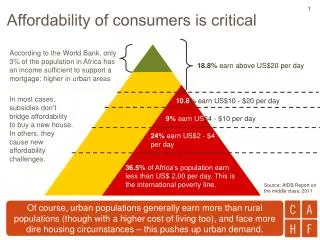
Affordability of consumers is critical According to the World Bank, only 3% of the population in Africa has an income sufficient to support a mortgage: higher in urban areas 18.8% earn above US$20 per day In most cases, subsidies don’t bridge affordability to buy a new house. In others, they cause new affordability challenges. 10.8% earn US$10 - $20 per day 9% earn US$4 - $10 per day 24% earn US$2 - $4 per day 36.5% of Africa’s population earn less than US$ 2,00 per day. This is the international poverty line. Source: AfDB Report on the middle class, 2011 Of course, urban populations generally earn more than rural populations (though with a higher cost of living too), and face more dire housing circumstances – this pushes up urban demand.
And understanding their capacity, opens up opportunities 5. Build solid data / information platforms to sharpen & target investments and incentives According to the World Bank, only 3% of the population in Africa has an income sufficient to support a mortgage 1. Increase access to mortgage finance 2. Grow & develop housing microfinance. 3. Finance rental housing 18.8% earn above US$20 per day 10.8% earn US$10 - $20 per day 9% earn US$4 - $10 per day 24% earn US$2 - $4 per day 6. Pursue policy interventions along the value chain 36.5% of Africa’s population earn less than US$ 2,00 /day. This is the international poverty line. Urban populations need most support – rural can manage with self-build, though do need water. 4. Target subsidies carefully Source: AfDB Report on the middle class, 2011 New players are beginning to carve out niche markets, serving a wider population / policy makers are recognising the value of partnerships