Understanding Echinoderms: Characteristics and Diversity of Phylum Echinodermata
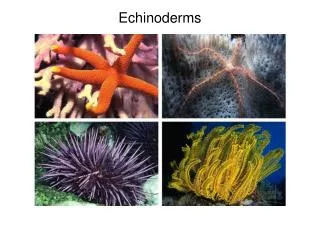
Echinoderms, belonging to the Phylum Echinodermata, are marine animals characterized by their unique features. They exhibit bilateral symmetry in larvae and pentaradial symmetry in adults. Their endoskeleton is made of calcium carbonate plates, and they possess a water vascular system for locomotion and feeding. Major classes include Crinoidea (feather-like arms), Asteroidea (starfish with arms), Ophiuroidea (brittle stars), Echinoidea (urchins and sand dollars), and Holothuroidea (sea cucumbers). Echinoderms play crucial roles in marine ecosystems, both as predators and scavengers.

Understanding Echinoderms: Characteristics and Diversity of Phylum Echinodermata
E N D
Presentation Transcript
Echinoderms Thu Truong
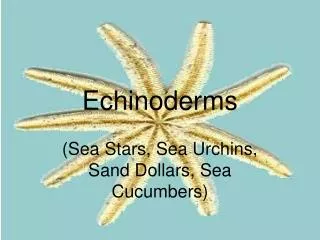
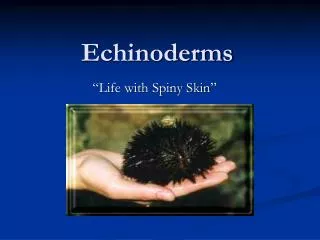
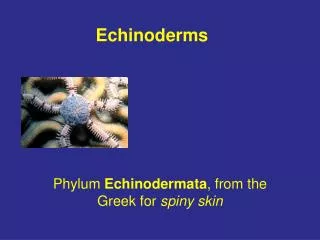
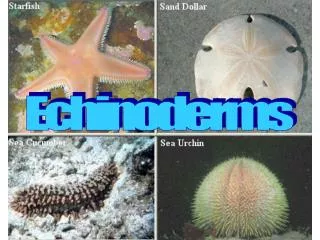
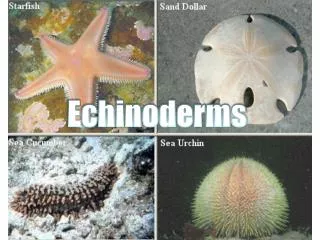
Phylum: Echinodermata "echino" - sea urchin, "spiny" "derm" - skin Example animals: Starfish Brittle Star Sea Urchin Sand dollar
General Characteristics • Larvae - Bilateral Symmetry, cilliated, free-swimming • Adults - Pentaradial Symmetry • Endoskeleton - consists of calcium carbonate plates and spines, w/ thin cilliated epidermis • Pedicellariae - modified spines, pincer-like, keeps surface clean • Water Vascular System - network of fluid-filled canals that function in locomotion, feeding, and gas exchange. • Branches of the WVS become extended when filled with fluid (tube feet) • Ampulla - round muscular sac at the base of the foot, stores fluid and operates tube foot • Well developed coelom, but no excretory organs. • Digestive system most prominent, simple nervous system • Sexes are separate, both eggs and sperm are released into water
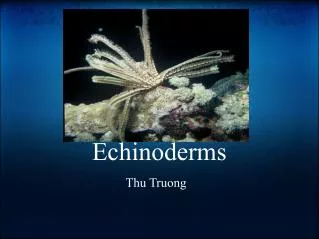
Class: Crinoidea • Anatomy • Stalk - makes them sessile • "arms" resemble feather structure • Feeding/Behaviors • Remove suspended food from water • Oral surface is on upper side of disk • Tentacles coated with mucus to capture organisms
Class: Asteroidea • Anatomy • Central disk, has 5 to more than 20 arms - tube feet underneath • Mouth lies on underside of the disc • Endoskeleton - series of calcareous plates, enables limted movement, moves slowly • Feeding/Behaviors • Carnivorous, eats by attaching itself to prey and secretes digestive enzymes • Gas Exchange/Secretion • Poorly developed circulatory system, rely mainly on coelom and coelomic fluid • Wastes are diffused outside through the tube feet and dermal gills • Reproduction • Sexual or Asexual
Class: Ophiuroidea • Anatomy • Bodies similar to asteroidea, but the arms are more slender, enables it to move quicker • Tube feet not used in locomotion • Feeding/Behaviors • Tube feet used to collect and handle food
Class: Echinoidea • Anatomy • Have NO arms, skeletal plates are flattened into a solid shell called a test • Sand dollars have flat bodies adapted for burrowing • Sea urchins have bodies covered with spines, move by tube feet • Feeding/Behaviors • Sand dollars feed on tiny organic particles in sand • Sea urchins feed on algae on the ocean floor with calcareous teeth
Class: Holothuroidea • Anatomy • Elongated flexible body (muscular sac), mouth surrounded by circle of tentacles (modified tube feet) • Reduction of endoskeleton to microscopic plates • Highly developed Circulatory system, transports oxygen + nutrients • Feeding/Behaviors • Slow, live on bottom floor • Eviscration - digestive tract, respiratory structures, and gonads ejected from body (unfavorable conditions) • Response to Stimuli • if irritated will attack (shoots red tubules)