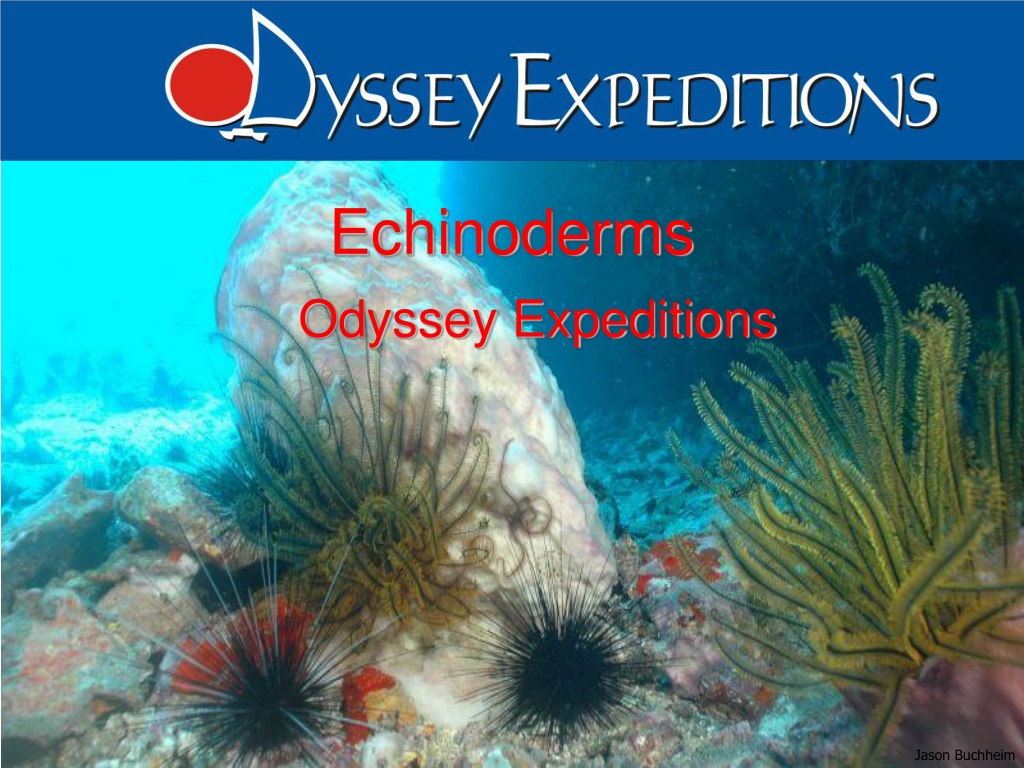
Echinoderms Odyssey Expeditions Jason Buchheim
Introduction • Entirely marine • Typically bottom dwellers • Generally posses pentamerous radial symmetry at some point in life cycle (most can be divided into five parts around a central axis) • Internal skeleton composed of calcareous ossicles (small plates)
Water vascular system in blue Introduction • Sexes are generally separate • External fertilization • Planktonic development • Many have water vascular system (hydraulic system) for food collection and locomotion. • Motion accomplished by transmitting water pressure.
Classes • Class Asteroidea • Class Ophiuroidea • Class Echinoidea • Class Holothuroidea • Class Crinoidea • Class Concentricycloidea
NOAA Class Asteroidea • Sea stars • 1,800 species • Typically have five arms • Regeneration capabilities (in some a new animal is formed) • Mouth on bottom (centrally located) • Anus on top
Organs in arms Class Asteroidea • Carnivores, detritivores, opportunists, mud swallowers • Some can invert stomachs out mouth to surround prey • Bivalve predators slide stomach between valves and feed on the organism while outside the body • Organs distributed in arms
Podia Class Asteroidea • Two to four rows of podia (tube feet) extend down each arm from the mouth • Used for prey capture and locomotion • Podia extended by hydraulic pressure • Pressure generated by contraction of bulblike ampulla • In many, suckers are found on podia • Arms can twist and bend allowing locomotion over varied terrain
NOAA Class Ophiuroidea • Brittle and Basket Stars • Largest class (2,000 species) • Mouth is centrally located on the underside of body • Highly mobile • Long thin arms • Organs in central disk not arms • Podia typically not responsible for locomotion • Use arms to push and pull themselves along
Class Ophiuroidea • Two distinct orders • Order Ophiurae • Brittle Stars • Order Euryalae • Basket Stars
NOAA NOAA Order Ophiurae • Five arms generally heavily spined • Calcareous plates (arm shields) on arm tops allow only lateral movement • Arms break off easily • Generally hide in crevices and under rocks during the day • At night move into open to feed • Feed on detritus and small animals
Jason Buchheim Order Euryalae • Have five arms that continually divide into smaller branches • Lack arm shields which enables full movement • During day can be found curled into a ball clinging to gorgonians • At night they stretch out their arms to filter out plankton that drifts over the reef • Small spines and tube feet move food to mouth
Jason Buchheim Class Echinoidea • Sea urchins, sand dollars and heart urchins • 1,000 species • Moveable spins cover theses animals • No arms • Circular or oval • Globular or flattened • Some display secondary bilateral symmetry
Class Echinoidea • Ossicles are fused to create a solid structure called a test • Two basic groups: • Regular Urchins (sea urchins) • Irregular Urchins (heart urchins, sand dollars, sea biscuit)
Jason Buchheim Regular Urchins • Sea Urchins • Generally globular in shape • Covered with long moveable spines (some long and pointed some short and stubby) • Anus on top
Mouth Regular Urchins • Mouth centrally located on underside • Scrape algae with their unique five teeth arrangement call Aristotle’s Lantern • Important to the reef because of the algae control they provide.
USGS Irregular Urchins • Heart urchins, sand dollars, and sea biscuits • Evolved to specialize in burrowing • Small moveable spines cover the body and are used for burrowing • Two orders: • Order Spatangoida (heart urchins) • Order Clypeasteroida (sand dollars and sea biscuits)
NOAA Order Spatangoida • Heart urchins • Oval dome-like in shape • Feed on organic materials in the substrate • Mouth (lacks Aristotle’s Lantern) in front and anus in back • Typically found buried in the substrate • May be seen at night
USGS Order Clypeasteroida • Sand dollars and sea biscuits • Flattened disk shape • Mouth centrally located on the underside with Aristotle’s Lantern • Anus found towards rear • Live buried in the sand
Odyssey Expeditions Class Holothuroidea • Sea cucumbers • Tubular in shape • 1,000 species • Mouth in front and anus in rear • Most feed on organics found in the sand that they consume • Some filter feed
Class Holothuroidea • Tube feet cover the bottom surface • If threatened can expel most of their guts • Can regenerate these guts
Class Crinoidea • Feather stars (Crinoids) • Oldest echinoderms (living fossils) • 600 species • Five arms that fork to give ten or more • Look like feathers • Arms are sticky and sweep water for food particles • Can regenerate arms Jason Buchheim
Jason Buchheim Class Crinoidea • Can move short distances • Some swim with arms • Others walk on legs called cirri
Resources • Barnes, Robert D. and Edward Ruppert. Invertebrate Zoology: Sixth Edition. Fort Worth: Saunders College Publishing, 1994 • Humann, Paul and Ned Deloach. Reef Creature Identification: Florida Caribbean Bahamas. Florida: New World Publications, Inc., 2003 • Kinsella, John, Drew Richardson and Bob Wohlers. Life on an Ocean Planet. California: Current Publishing Corp., 2006 • Taylor, Walter K. and Robert L. Wallace. Invertebrate Zoology: A Laboratory Manual Sixth Edition. New Jersey: Prentice Hall, 2002