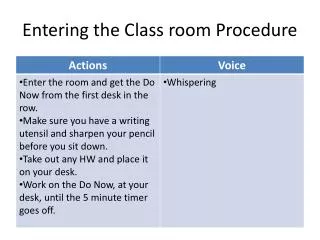
Entering the Class room Procedure
This agenda outlines essential classroom procedures and expectations to foster a productive learning environment. Key elements include daily goals, strategies for improvement, and methods for measuring progress, such as exit tickets and assessments. Students are encouraged to reflect on their prior performance and set new benchmarks for growth in mathematical concepts, particularly in graphing inequalities. Emphasis is placed on hard work, kindness, and accountability, creating a supportive atmosphere where all learners can strive to reach their full potential.
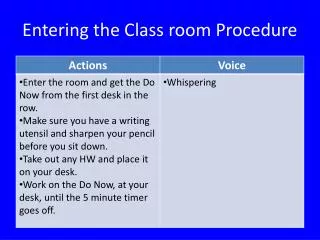

Entering the Class room Procedure
E N D
Presentation Transcript
Agenda • Do Now • Procedures and Expectations • Goals, Goals, Goals • Notes • How Far Can You Go? • Reminders • Exit Ticket
Each day I will… • Work Hard • Be Kind • Take Responsibility • Make it Right
Let’s set a new goal… • Think about what category you were in based on the last Think Link test. Below Basic? Basic? Proficient? Advanced? • Our Goal: All students will move up 1 category. • End of the year goal: All students on grade level (proficient or advanced) so you can have all the opportunities possible for 8th grade, high school, and beyond.
Next Discovery Test – One Week • We want to move up 1 category! • Below Basic BasicProficientAdvanced • TO HAVE SUCCESS WE MUST HAVE HARD WORK!
Never Make Excuses!! • Don’t get down on yourself for where your score WAS, that was before we had worked so hard. • No excuses, let’s improve!!
I can graph inequalities by plotting solutions on a number line.
What does this look like in real life? Lisa is having a sleep over and her mom says she can have no more than 8 girls come and spend the night. She already told Laura and Jill to come, how many more people can she invite? 2 + x < 8 My solution means:
Check for Understanding • Use inequality signs to make these true: • 5 _____ 2 -4 ______ 8 12 ______ 11 • Solve just like equations: Use _______ to _________ the variable.
Number Line #’s get smaller (negative) 0 is in middle #’s get bigger (positive)
Example 1 1) ½x > 20 So this means… x could be any number _____________________, such as ________________________________________________
Example 2 2.) 11x + 5 < 10 So this means… x could be any number _____________________, such as ________________________________________________
Example 3 3) -2x + 11 < 3 So this means… x could be any number _____________________, such as ________________________________________________
Example 4 4) -1/4x – 4 > -28 So this means… x could be any number _____________________, such as ________________________________________________
Green and Red Groups IXL, master 1 objective per week Objectives G.1-G.15, Operations with fractions Accelerated Math 8 objectives to print a test 8 tests in the 9 week period Test grades count as Quiz grade Blue and Yellow Groups Accelerated Math 8 objectives to print a test 6 tests per 9 week period Accelerated Math Grade
Exit Ticket • Draw four number lines, from negative six to positive six. Solve and graph the following: • x + 5 < 10 • -3d > 9 • 2f – 3 ≥ 3 • -1/2 +1 ≤ 1
Intervention DO NOW 1.) 2 + 5n = 12 2.) 4b - 5 = 23 3.) 3x + 8 = 29 4.) 1/2d – 5 = 2 5.) 3 + 1/3x = 5 6.) -4 + 3s = 8 7.) -2 – ½g = 4
Intervention DO NOW CHECK 1.) 2 + 5n = 12 2.) 4b - 5 = 23 3.) 3x + 8 = 29 4.) 1/2d – 5 = 2 5.) 3 + 1/3x = 5 6.) -4 + 3s = 8 7.) -2 – ½g = 4
Intervention: KCC before isolating variable • Before using inverse operation, must do keep, change, change with a subtraction problem that has two negatives beside each other. Not necessary when the subtraction signs are not next to each other. Example 1: R – (-10) = 15 Example 2: D – (-3) = 5 Example 3: R – 2 = 10
Stop and Jot 1 1. R – (-10) = 20 2. D – (-2) = 4 3. R - 4 = 10
Multiply and Divide on Same Side • When you have multiplication and division on the same side of the equation, you always want to do the inverse of the division, so multiply both sides first!! • Example 1: 1/2z (4) = 8 • Example 2: (1/3p)(3) = 4
Stop and Jot 2 1.) 1/2z (5) = 10 2.) (1/4p)(4) = 4
Like Terms in Equations • When have like terms on the same side of the equal sign, you must combine them! • After combining then you separate the constant from the coefficient and isolate the variable.
STOP AND JOT 3 1.) 4 - 5x – 3 = 26 2.) 5 + 1/2x – 3 = 7 3.) 5x + 4 - 2x - 2 = 17
STOP AND JOT 4 1.) 4 – (-5x) – 3 = 26 2.) 5 + 1/2x – (-1) = 7 3.) 5x + 4 – (-2x) - 2 = 19
Exit Ticket 1.) 3b – (-7) + 2b + 2 = 34 2.) 4x + 6 + x -2 = 14 3.) 7c – c -3 + 2 = 23 4.) 1/2d – 3 - (-2) = 5