Exploring Properties of Matter Through Scientific Method in the Laboratory
This guide outlines the scientific method and emphasizes safety while exploring the properties of matter, including solids, liquids, gases, and their densities. It covers the purpose of experiments, formulation of hypotheses, selection of materials, and detailed procedures to follow in the lab. Observations and results should be meticulously recorded in a notebook designed for scientific inquiries. Safety guidelines stress the importance of using protective gear, following instructions, and maintaining a clean workspace. A structured approach fosters a comprehensive understanding of buoyancy and the behavior of particles in various states of matter.

Exploring Properties of Matter Through Scientific Method in the Laboratory
E N D
Presentation Transcript
Scientific method, safety, purpose, hypothesis, materials, procedure, results, conclusion, matter, mass, solid, liquid,gas, particles, volume Density, buoyancy properties of matter
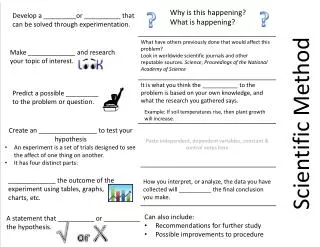
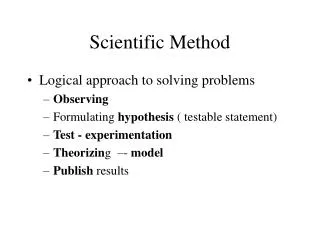
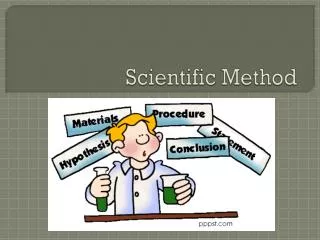
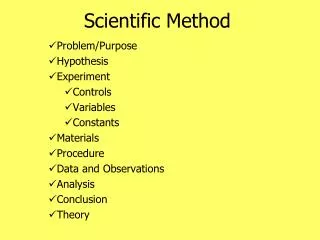
Scientific method • Purpose • Hypothesis • Materials • Procedure • Data and Results • Observation • Conclusion
Safety in Science • Listen to the teachers’ instructions. • Wear safety gears (lab gowns, goggles, gloves) when working in the lab. • Do not touch, smell or taste anything without the teacher’s permission. • Practice wafting (smell by waving from the object towards you) • When something breaks inform the teacher right away • Clean and put everything in order spot before leaving the lab.
Notebook/Journal in Science • Each student in science class will have a notebook which will be used for record keeping of concepts, data and results, experiments, questions to ponder.
Guidelines in preparing your journal • Write your name and grade level in the first page of your journal. • Skip 4 pages from the name page. • From then on, number all the pages from 1 at the upper right hand corner of each page. • At the very last page of your journal, draw a circle at the lower left corner of all the pages of your journal.