
CH 3 Forces
E N D
Presentation Transcript
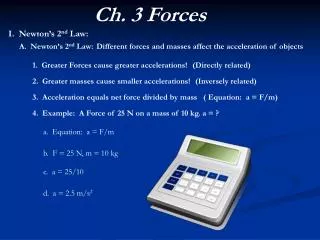
Sec 1 Newton’s 2nd Law • Net force acting on an object causes the object to accelerate in the direction of the net force • Amount of “a” depends on the mass of the object and the size of the net force F = m x a • Force is measured in Newtons (N), m=kg, a=m/s2 • So…. 1 N = 1 kg x 1 m/s2
Let’s Practice! • How much force is needed to accelerate an 80 kg rider and her 320 kg motorcycle at 6 m/s2? • It takes a force of 3000 N to accelerate an empty 1000 kg car at 3m/s2. If a 160 kg wrestler is inside the car, how much force will be needed to produce the same “a”? • A 75 kg skater pushes off from a wall with a force of 300 N. What is the skater’s “a”?
Types of Friction • Friction (f) is the force that opposes motion between 2 surfaces that are touching each other • Amount depends on surface types and amount of force pressing surfaces together • 3 different types: • Static-prevents 2 surfaces from sliding past each other • Sliding-opposes the motion of 2 surfaces sliding past each other • Rolling-frictional force between a rolling object and the surface it is rolling on
Air Resistance • Force that opposes gravity on a falling object • Depends on 4 things: • Speed • Shape • Density • Size • Air resistance is why a feather falls slower than an object of the same mass but has a different shape
Terminal Velocity • Highest velocity that will be reached by a falling object • Air resistance balances the pull of gravity • According to the Law of Inertia, when the forces acting on an object are balanced, the motion of the object will not change and acceleration will stop
Sec 2 Gravity • Gravity (g)– force that every object in the universe exerts on every other object in the universe • Amount depends on the 2 objects masses and the distance between them • That is why a pencil falls to the floor (Earth) and not toward you when you drop it
Falling objects • Ignoring all forces except gravity on falling objects, the object is said to be in “free fall” (more later…) • Then all objects would fall with the same acceleration and hit the ground at the same time when dropped from same height (Let’s try it!) • That acceleration is 9.8 m/s2
Weight • Even if you are standing still, Earth exerts a gravitational force on you • This is your weight (W) in Newtons • W = m x g • m= your mass in kg • g= acceleration of gravity (m/s2) which is 9.8 m/s2 • W = m x 9.8 m/s2 • Try converting your weight in kgs (divide lbs by 2.2) to N
Weight and Mass • They are NOT the same measurement • Weight is a force and mass is the amount of matter an object contains • Compare your weight in N on Earth to the other planets (pg 78) • Which one would you weigh the most? The least? • Astronauts in space only appear to be weightless—they seem to be floating because they are inside the shuttle and they are all falling with the same acceleration
Projectile Motion • Anything thrown or shot through the air is called a projectile • They follow a curved path due to Earth’s gravitational pull and its own inertia • When the quarterback throws the ball it has horizontal motion (parallel to the Earth’s surface) due to inertia • Gravity pulls the ball to Earth, creating an increasing vertical motion • These 2 motions are independent of each other
Circular Motion • Acceleration toward the center of a curved or circular path is called centripetal acceleration • Force that causes a moving object to move in a curved or circular path is centripetal force • Gravity, the ultimate centripetal force: Earth’s gravity exerts this force on the Moon which causes it to move in a circular orbit around the Earth
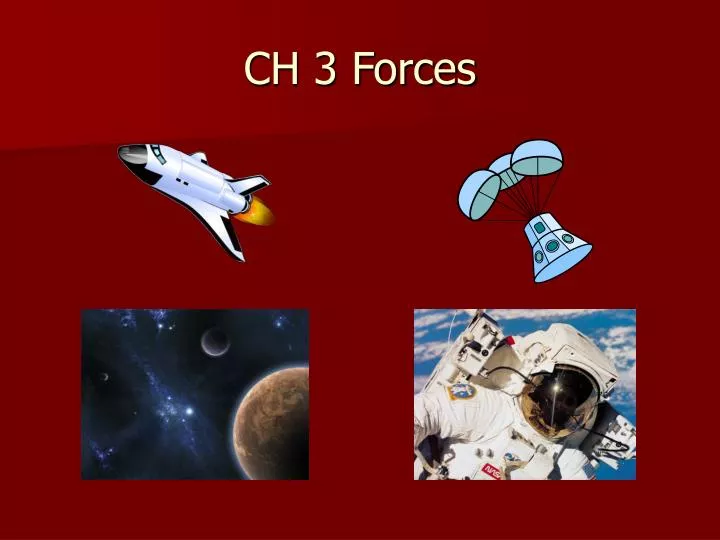
Sec 3 The 3rd Law of Motion • Forces always act in pairs—action/reaction pairs • Newton’s 3rd Law—to every action there is an equal and opposite reaction • Action/reaction forces always act on different objects, so forces might be equal, but they are NOT balanced • Action—rockets burn fuel and produce hot gases that push against the inside of the rocket and escape out the back • Reaction—causes the rocket to move in the opposite direction • Let’s try it: Balloon Racers!
Momentum • Property a moving object has due to its mass and velocity • Designated by “p” • p = m x v • kg·m/s = kg x m/s Practice! • A horse with a mass of 450.0 kg finished a race with a velocity of 20.0 m/s. What was his “p”? • What was the mass of another horse that was running at a velocity of 18.0 m/s if his “p” was 7500 kg·m/s? • Law of Conservation of Momentum– the total amount of p of a group of objects does not change unless outside forces act on the objects.
Law of Conservation of Momentum • The total amount of p of a group of objects does not change unless outside forces act on the objects • BUT…p can be transferred from one object to another