
SlideServe
Menu
Préférences
© SlideServe · v2026

Understanding Forces in Motion

tricia avatar
9 diapositives · 181 Views · Aug 15, 2014

Learn about forces and how they impact the motion of objects, including contact and field forces. Explore the concepts of balanced and unbalanced forces and the role of friction in motion. Discover how friction can be both helpful and harmful and ways to mitigate its effects on objects.
Understanding Forces in Motion - slide 1
01 / 9Understanding Forces in Motion
1 / 17

Télécharger la présentation

Understanding Forces in Motion
Une image / un lien ci-dessous est fourni (tel quel) pour télécharger la présentation

Politique de téléchargement : le contenu du site vous est fourni TEL QUEL pour votre information et votre usage personnel ; il ne peut être vendu, concédé sous licence ni partagé sur d’autres sites sans l’accord de son auteur.Le contenu vous est fourni TEL QUEL, pour votre information et votre usage personnel uniquement. Téléchargez la présentation en cliquant sur ce lien. Lors du téléchargement, si vous ne parvenez pas à télécharger une présentation, l’éditeur a peut-être supprimé le fichier de son serveur.Pendant le téléchargement, si vous ne parvenez pas à obtenir une présentation, le fichier a peut-être été supprimé par l’éditeur.

F I N

Plus de contenu associé

Transcription de la présentation
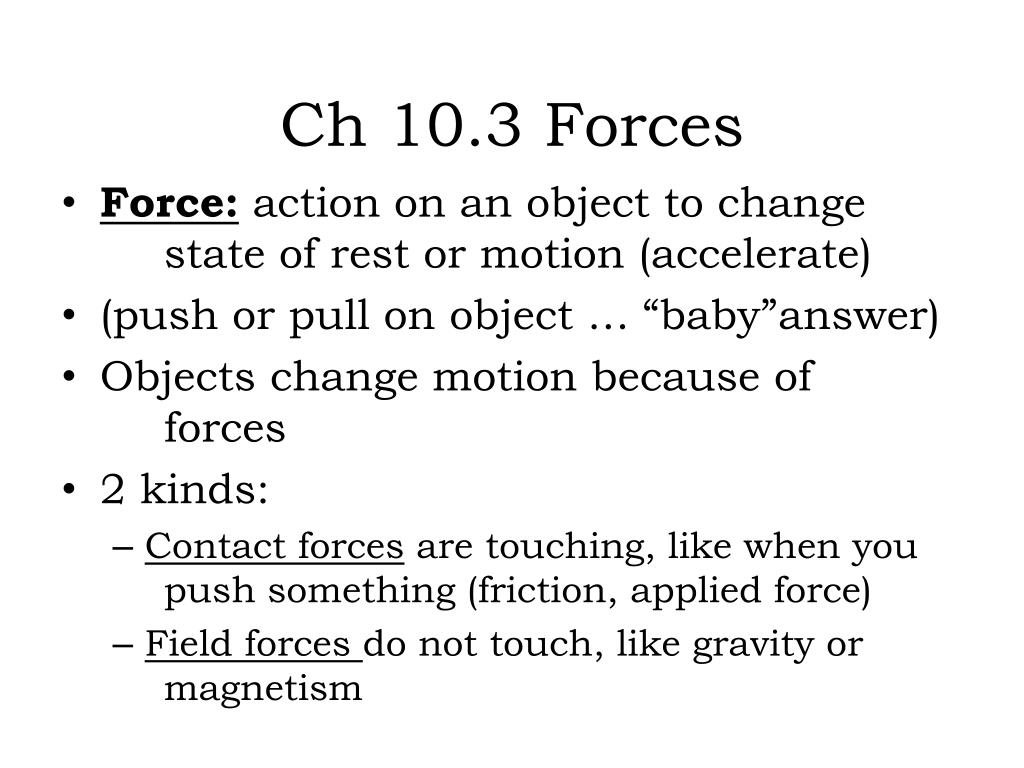
  1. Ch 10.3 Forces • Force: action on an object to change state of rest or motion (accelerate) • (push or pull on object … “baby” answer) • Objects change motion because of forces • 2 kinds: • Contact forces are touching, like when you push something (friction, applied force) • Field forces do not touch, like gravity or magnetism

  2. Net forces • Net force: total of all forces acting on object • if net force = 0 • forces are balanced • object does not change rest/motion • if net force is not 0 • forces are unbalanced • object changes state of rest/motion (accelerates)

  3. Net forces • Important distinction: • Not true that something that has balanced forces isn’t moving. It could be moving at a constant velocity (speed and direction) • True that something with balanced forces is not accelerating (changing speed, direction or both) • Balanced forces = constant motion • Unbalanced forces = acceleration (change in motion)

  4. Balanced and Unbalanced • So the reason things move differently, in a scientific sense, is that it’s being acted on by unbalanced forces. • Can something be moving when the forces on it are balanced? • Yes…but it won’t accelerate. It is moving at a constant speed and direction.

  5. Balanced or unbalanced? • Car moving in a straight line, 65 mi/hr • Car slowing down • Car parked • Car turning a corner • Car speeding up • Car stopped at a stoplight with engine running

  6. Balanced or unbalanced?

  7. The Force of Friction • Friction: acts against motion of an object (opposite direction of motion) • static: when objects not in motion (parked car on hill) • kinetic: when things are moving (tires on road around turn) • Can be rolling or sliding • Air resistance: form of friction with air molecules

  8. Friction and Motion • Friction can be good or bad • Bad: parts in engine rub together. Decrease by: • lubricant (oil) • replace sliding with rolling (wheels, ball bearings) • smooth surfaces • Good: keeps car on road. Increase by adding • more force • rougher surface