Implementing Search
This lecture provides an in-depth exploration of search algorithms essential for artificial intelligence, focusing on their implementation in Lisp. Key topics include state representation, operators, goal tests, and path costs for various puzzles like the 8-puzzle, 8-queens, and cryptarithmetic problems. The lecture covers different search strategies including breadth-first, depth-first, bidirectional search, and informed versus uninformed searching techniques. By analyzing their completeness, time and space complexities, and optimality, participants will gain valuable insights into efficient problem-solving methods in AI.

Implementing Search
E N D
Presentation Transcript
Implementing Search Lecture 2-2 January 14th/19th, 1999 CS250 CS250: Intro to AI/Lisp
8-Puzzle • States? • Operators? • Goal test? • Path cost? CS250: Intro to AI/Lisp
8-Queens • Place 8 queens on a chess board, with no one attacking any other • Goal test? • Path cost? • States • Operators? CS250: Intro to AI/Lisp
Cryptarithmetic • Puzzles with numbers replaced by letters FORTY + TEN + TEN ===== SIXTY CS250: Intro to AI/Lisp
Missionaries & Cannibals • Three missionaries and three cannibals wish to cross a river in a boat that won’t hold all three • States? • Operators? • Goal test? • Path cost? CS250: Intro to AI/Lisp
Real-World Problems • Route finding • TSP • VLSI • Robot navigation • Paint booth scheduling CS250: Intro to AI/Lisp
Search Trees CS250: Intro to AI/Lisp
What’s in a Node? • State - what state are we in? • Parent - Which node generated the current node? • Operator - Action which generated node from parent • Node depth - Number of nodes from root • Cost - Path cost from initial node CS250: Intro to AI/Lisp
Lieutenant Node & General Search function GENERAL-SEARCH(problem, QUEUEING-FN) returns solution or failure nodes MAKE-QUEUE(MAKE-NODE(INITIAL-STATE[problem])) loop do ifnodes is empty thenreturn failure node REMOVE-FRONT(nodes) if GOAL-TEST[problem] applied to STATE(node) succeeds then return node nodes QUEUING-FN(nodes, EXPAND(node, OPERATORS[problem])) end CS250: Intro to AI/Lisp
Coding Goals • Create the initial node list • Need the right ordering • Write a loop • If test • Functions for: • QUEUEING-FN, REMOVE-FRONT, GOAL-TEST, EXPAND, MAKE-NODE CS250: Intro to AI/Lisp
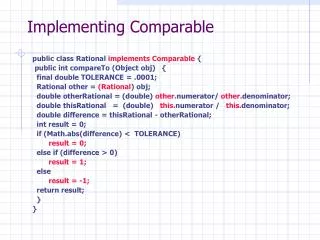
In Lisp... (defun general-search (problem queuing-fn) "Expand nodes according to the specification of PROBLEM until we find a solution or run out of nodes to expand. The QUEUING-FN decides which nodes to look at first. [p 73]” (let ((nodes (make-initial-queue problem queuing-fn)) node) (loop (if (empty-queue? nodes) (RETURN nil)) (setq node (remove-front nodes)) (if (goal-test problem (node-state node)) (RETURN node)) (funcall queuing-fn nodes (expand node problem))))) CS250: Intro to AI/Lisp
A Few Lisp Ends special form: A list (but not a macro), which is a form with special syntax or special evaluation rules or both, possibly manipulating the evaluation environment or control flow or both. The first element of a special form is a special operator. (setq var1 form1 var2 form2 ...) return terminates a loop and returns the value of the specified expression as the value of the loop CS250: Intro to AI/Lisp
Dumb & Smart Searching • Does the search algorithm use information beyond GOAL-TEST? • Uninformed/blind searching does not • Informed/heuristic search does CS250: Intro to AI/Lisp
Factors in Search Strategy • Completeness - Are we guaranteed to find a solution, if one exists? • Time complexity - How long does it take? • Space complexity - How much memory? • Optimality - Find the best of several solutions? CS250: Intro to AI/Lisp
Different Strokes for Different Searches • Why is GENERAL-SEARCH general? CS250: Intro to AI/Lisp
Breadth-First Search • Go sideways before you go down • How do we do this in GENERAL-SEARCH? • How good is it? • Completeness? • How long does it take? • How much memory? • Optimality? CS250: Intro to AI/Lisp
Uniform Cost • BFS: No shorter path is a solution, but what about cost? • Uniform cost expands the lowest cost node • When is BFS also uniform? g(node) = DEPTH(node) CS250: Intro to AI/Lisp
Depth-first Search • Go down before you go sideways • Saves memory over BFS - why? • How good is it? • Completeness? • How long does it take? • Optimality? • Depth-limited search CS250: Intro to AI/Lisp
Iterative Deepening Search • Repeated depth-limited search • Depth 0, depth 1, depth 2, … • Same states expanded multiple times • Higher branching factors make repeated expansion less important • How good is it? • Good choice when: • Big search space • Unknown solution depth CS250: Intro to AI/Lisp
Bidirectional Search • Start from the beginning and the end, meet in the middle • Divide and conquer • Cut the depth of each search in half • From O(bd) to O(2bd/2) • For b = 10, d = 6: • BFS searches 1,111,111 • Bidirectional searches 2,222 CS250: Intro to AI/Lisp
Sounds Great, Where do I Sign Up? • Searching backwards? • Calculating predecessors can be tricky • Many goal states are a problem • Generate a node and ask, “Is it in the other half of the tree?” • Different halves can have different searches CS250: Intro to AI/Lisp
Search Comparison d = depth of the goal m = max tree depth l = depth limit CS250: Intro to AI/Lisp
And the Winner is... • Depth-first iterative deepening • Asymptotically optimal in time • Asymptotically optimal in space among blind searches that find optimal solutions CS250: Intro to AI/Lisp
Constraint Satisfaction Search • Constraint Satisfaction Problem (CPS): additional structural properties • States are values of a set of variables • Goal test specifies constraints on variable values • Unary - cryptarithmetic • Binary - 8-Queens • 3rd and higher-order • Absolute or just nice to have CS250: Intro to AI/Lisp
Why Bother? • Less general than the notion of ‘problem’ • More efficient algorithms • Constraints are fine-grained CS250: Intro to AI/Lisp
Domains • Variables Vi have domains, Di • Discrete or continuous? CS250: Intro to AI/Lisp
AIMA Code (for homework) • Code from AIMA /courses/current/CS250/Code/AIMA/doc/overview.html CS250: Intro to AI/Lisp