Download
1 / 14
140 likes | 267 Vues
This overview covers the structure and functions of Pennsylvania's legislative branch, known as the General Assembly, which is bicameral and consists of the State House of Representatives and the State Senate. The bill-making process is outlined, showing how a bill becomes law in a manner similar to the U.S. Congress. Key officials, such as State Senator John Eichelberger and State Representative Rick Geist, are mentioned, along with the importance of adhering to federal law. Additionally, the challenges related to state budgeting and the roles of the executive and judicial branches are briefly discussed.

E N D
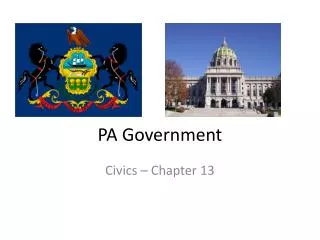
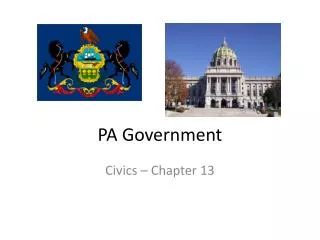
PA Government Civics – Chapter 13
Legislative Branch (General Assembly) • Federal level: Congress • State level: General Assembly • The General Assembly is bicameral (2 houses) • State House of Representatives (203) • Senate Senate (50) • Districts are all equal based on POPULATION • Senators must be at least 25 years old • Reps. must be at least 21 years old
Our State Senator and Representative • State Senator • John Eichelberger • Republican • State Representative • Rick Geist • Republican
How a PA bill becomes law • Bill-making process very similar to US Congress • Bill starts out as idea • Introduced and drafted in committee • Debated on floor of one house • Sent to other house and debated • Revised in conference committee • Sent to Governor
One Important Note • The PA legislature cannot make any laws that go against federal laws or the Constitution. • If so, the US Supreme Court can eliminate them!
Budget Issue for States • Recently, many state legislatures (inc. PA) do not have the money to fund projects • Three possibilities: • Raise taxes to get more money • Cut programs to save money • Borrow money from federal government
The PA Executive Branch • Head of exec branch = governor • Current governor is Tom Corbett (R) • Qualifications • 30 years of age • Resident of PA for 5 years • American citizen • If governor leaves office, the lieutenant governor takes over (like VP)
Governor’s Responsibilities • Chief executive – in charge of PA agencies and departments • Chief legislator – proposes laws and signs or vetoes legislation by Gen. Assembly • Commander in chief of PA national guard • Party Leader (currently for Republicans)
Other roles of Governor • Pardon = forgiveness from crime • Commute = reduction in prison sentence • Parole = early release from prison • Can be made by governor • Usually done by committees of prison officials
The PA Judicial Branch • Jurisdiction deals only with Pennsylvania Law • Can be grouped into two types of groups: • Higher Courts (criminal/civil cases + appeals) • General trial courts • Appellate courts • State Supreme Court • Lower Courts (minor offenses) • Municipal courts • Traffic courts, juvenile courts, magistrate courts
PA vs. U.S. Supreme Court • The PA Supreme Court is NOT necessarily the last stop • The case can then go to the US Supreme Court in Washington, DC. • Usually involves violations of US Constitution or disputes with other states