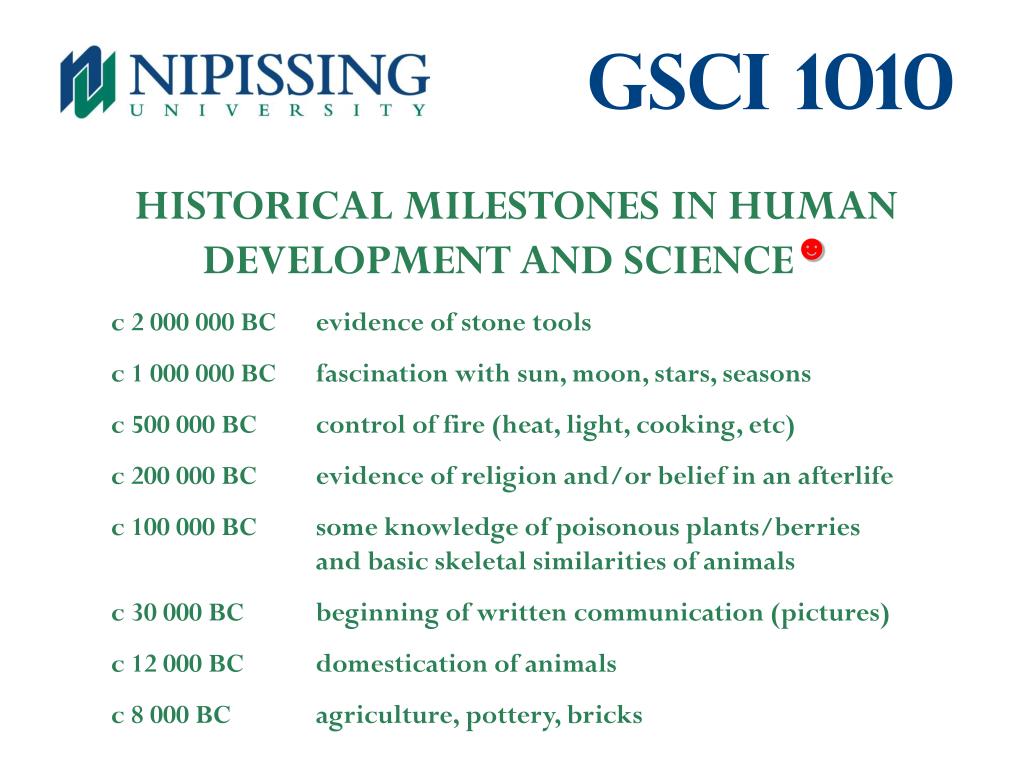
Gsci 1010 HISTORICAL MILESTONES IN HUMAN DEVELOPMENT AND SCIENCE☻ c 2 000 000 BC evidence of stone tools c 1 000 000 BC fascination with sun, moon, stars, seasons c 500 000 BC control of fire (heat, light, cooking, etc) c 200 000 BC evidence of religion and/or belief in an afterlife c 100 000 BC some knowledge of poisonous plants/berries and basic skeletal similarities of animals c 30 000 BC beginning of written communication (pictures) c 12 000 BC domestication of animals c 8 000 BC agriculture, pottery, bricks
Gsci 1010 HISTORICAL MILESTONES IN HUMAN DEVELOPMENT AND SCIENCE c 5 000 BC irrigation, first systems of measurement c 4 000 BC end of stone age, beginning of metallurgy (copper), sundial c 3 500 BC bronze age (tin/copper), hieroglyphic writing, papyrus, early machines (wheel, lever, plough) c 3 000 BC advanced cultures, astrology (sun, moon and several planets, with gods attached to their movements), discovery of c 2 500 BC astronomical year and seasons (Nile observed to overflow when Sirius rises with the sun)
Gsci 1010 HISTORICAL MILESTONES IN HUMAN DEVELOPMENT AND SCIENCE c 2 000 BC early calendar (12 months of 30 days), days of week named after sun/moon/planets, number system based on “60”, glass c 1 500 BC several languages with alphabets c 1 200 BC iron age c 600 BC libraries, coins c 500 BC geometry, theorem of Pythagoras, discovery of irrational numbers c 400 BC concept of the atom, advanced schools of philosophy (Plato)
Gsci 1010 HISTORICAL MILESTONES IN HUMAN DEVELOPMENT AND SCIENCE c 350 BC Aristotle and Aristarchus, geocentric vs heliocentric model c 300 BC advanced geometry (Euclid), similar triangles
Gsci 1010 HISTORICAL MILESTONES IN HUMAN DEVELOPMENT AND SCIENCE c 250 BC prediction of eclipses perfected, Eratosthenes determines the radius of the Earth 7, D 800 km Circumference = 2R km Accepted radius 6380 km!
Gsci 1010 HISTORICAL MILESTONES IN HUMAN DEVELOPMENT AND SCIENCE c 150 BC Hipparchus’ table of chords, beginning of trigonometry, catalog of stars and brightness Chord for 2 equals Chord for 360 - 2
Gsci 1010 HISTORICAL MILESTONES IN HUMAN DEVELOPMENT AND SCIENCE c 150 AD Ptolemy, law of sines, solving triangles, distance from earth to moon calculated Important Note:
Gsci 1010 HISTORICAL MILESTONES IN HUMAN DEVELOPMENT AND SCIENCE c 150 AD Ptolemy, law of sines, solving triangles, distance from earth to moon calculated Law of Sines
Gsci 1010 HISTORICAL MILESTONES IN HUMAN DEVELOPMENT AND SCIENCE c 150 AD Ptolemy, law of sines, solving triangles, distance from earth to moon calculated • From the diagram, • = 50 and = 180 – 70 = 110 So, = 20 By the sine law,
Gsci 1010 HISTORICAL MILESTONES IN HUMAN DEVELOPMENT AND SCIENCE c 150 AD Ptolemy, law of sines, solving triangles, distance from earth to moon calculated Thanks to Eratoshenes, Earth’s radius was known,i.e. AB = 6400 km. Also, on the diagram (not drawn to scale!), arc DB = 1675 km and 180 – = 15.26. Angle could then be found from, so Finally, using the sine law, and
Gsci 1010 HISTORICAL MILESTONES IN HUMAN DEVELOPMENT AND SCIENCE c 200 AD early algebra (middle east), Greco-Roman empire declines, beginning of “dark ages” (a lot of science probably “lost”) c 800 AD algebra continues to develop (middle east, India, far east), dark ages continue in Europe c 1 100 AD dark ages end, scholarship returns to Europe, first universities begin, scholars were often clergy c 1 500 AD early Renaissance period (da Vinci, Copernicus, Brahe) c 1 600 AD peak of the Renaissance (Kepler, Galileo, Descartes)
Gsci 1010 HISTORICAL MILESTONES IN HUMAN DEVELOPMENT AND SCIENCE c 1 650 AD classical physics and calculus formally develop (Newton, Huygen, Leibnitz) c 1 700 AD higher mathematics flourishes (Lagrange, Bernoulli, Laplace, etc) c 1 800 AD beginning of “industrial” and “scientific” ages (steam engine, atomic theory chemistry, thermodynamics, electricity, optics, spectrum analysis, etc) c 1 900 AD “modern physics” (atomic & nuclear physics, quantum mechanics, relativity theory, atom bomb) c 1 950 AD “space age” (satellites, moon landings, advances in astronomy)