SlideServe
Menu
Préférences
© SlideServe · v2026

Understanding the Consequences of a Warmer World and Ozone Depletion

connor-byers avatar
14 diapositives · 272 Views · Nov 20, 2014

This article delves into the misconceptions about climate change, explaining why even slight temperature increases matter. It highlights the local versus global climate variations, predicts the potential impacts on polar regions, and emphasizes the need for sustainable practices. The text also discusses ozone depletion caused by CFCs, its harmful effects, and solutions like the Montreal Protocol. It underscores the importance of immediate action in reducing emissions, adopting renewable energy, and protecting our environment for future generations.
Understanding the Consequences of a Warmer World and Ozone Depletion - slide 1
01 / 14Understanding the Consequences of a Warmer World and Ozone Depletion
1 / 17

Télécharger la présentation

Understanding the Consequences of a Warmer World and Ozone Depletion
Une image / un lien ci-dessous est fourni (tel quel) pour télécharger la présentation

Politique de téléchargement : le contenu du site vous est fourni TEL QUEL pour votre information et votre usage personnel ; il ne peut être vendu, concédé sous licence ni partagé sur d’autres sites sans l’accord de son auteur.Le contenu vous est fourni TEL QUEL, pour votre information et votre usage personnel uniquement. Téléchargez la présentation en cliquant sur ce lien. Lors du téléchargement, si vous ne parvenez pas à télécharger une présentation, l’éditeur a peut-être supprimé le fichier de son serveur.Pendant le téléchargement, si vous ne parvenez pas à obtenir une présentation, le fichier a peut-être été supprimé par l’éditeur.

F I N

Plus de contenu associé

Transcription de la présentation
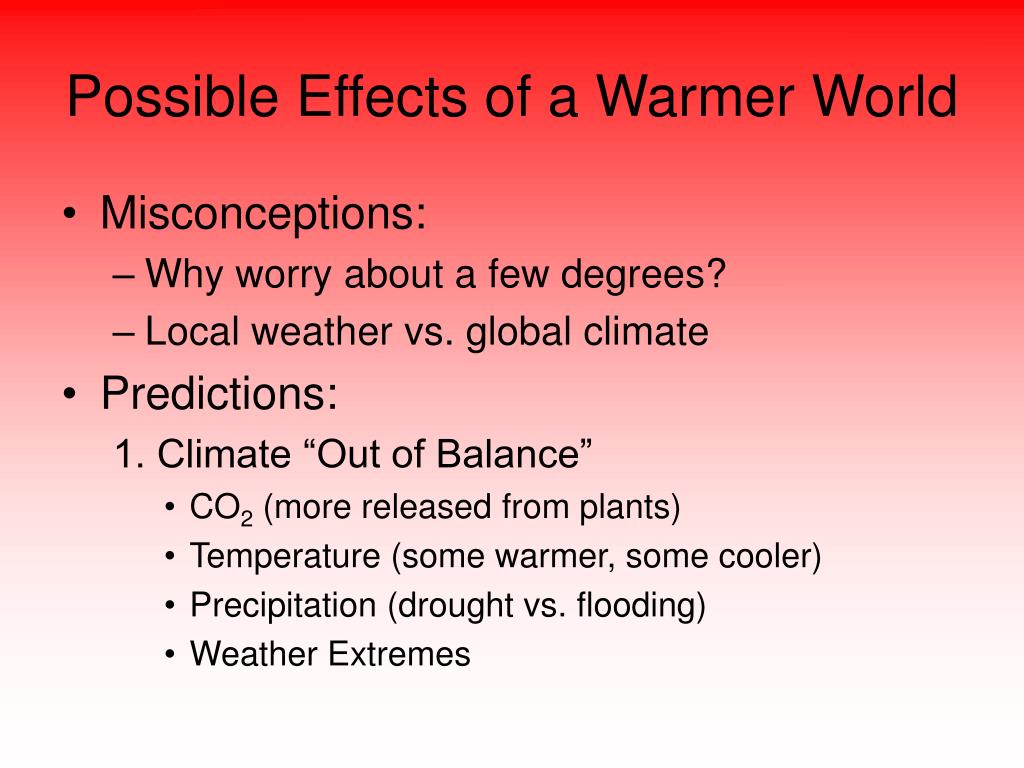
  1. Possible Effects of a Warmer World • Misconceptions: • Why worry about a few degrees? • Local weather vs. global climate • Predictions: 1. Climate “Out of Balance” • CO2 (more released from plants) • Temperature (some warmer, some cooler) • Precipitation (drought vs. flooding) • Weather Extremes

  2. Possible Effects of a Warmer World 2. Polar Regions • Large Polar Temp Change • Melting Ice (floating vs. land-based/sea level rise) • Decrease Albedo • Thaw Permafrost • Alter Biomes 3. Climate Shift (1°=100km/150m) • Can species adapt quickly enough? • Die-offs release more CO2

  3. Solutions to Climate Change • Do nothing • Research more, then act • Act now

  4. Dealing with Climate Change Human Activities Government Regulations Marketplace Removing CO2

  5. Human Solutions • Cut fossil fuel use • Improve energy efficiency • Transfer technology to developing countries • Shift to renewable energy use • Reduce deforestation • Use sustainable agriculture • Slow population growth

  6. US Government Regulation • Reduce subsidies for coal & oil use • Encourage shift to natural gas use and energy efficient technologies • Emphasize methane reduction • Agree to meet global GHG standards • Carbon and energy taxes • Fund transfer of technology • Increase nuclear power use • Establish policies/global funding for ZPG

  7. Marketplace • Competition for companies • reducing carbon emissions • develop more efficient technology

  8. Removing CO2 • Sequestering Carbon • Plant trees • Capture and pump deep underground • Inject into deep ocean

  9. Stratospheric Ozone Depletion • History: • Chlorofluorocarbons (CFC) • CFC-11 (trichlorofluoromethane, CCl3F) • CFC-12 (dichlorodifluoromethane, CCl2F2) • Uses • AC coolants (freons) • Aerosol cans • Cleaners • Plastics

  10. Stratospheric Ozone Depletion • What’s the problem? • Release of CFCs into atmosphere • Insoluble in water • CFC breakdown  O3 breakdown • Lag-time 10-20 years • Residence time = 75-100yrs • 1 CFC destroys 100,000 O3 Formation Destruction

  11. Stratospheric Ozone Depletion • Why worry? (effects of depleted ozone) • Increased exposure to UV radiation • Increased skin cancer • Increased cataracts • Immune system suppression • More photochecmical smog in troposhere • Lower crop yields • Decreased forest and aquatic productivity

  12. Protecting Stratospheric Ozone • Stop producing CFCs • Find substitutes • HFC (hydrofluorocarbons) • Hydrocarbons • Ammonia • Water/steam • Terpenes • Helium

  13. Protecting Stratospheric Ozone • Montreal Protocol (1987) • CFC phase-out by 2010 • Developed fund developing countries http://www.multilateralfund.org/ • CFC production has dropped 90%

  14. Links • NASA Ozone Research Page • http://ozonewatch.gsfc.nasa.gov/index.html