Download
1 / 38
380 likes | 490 Vues
This resource provides an extensive overview of gas laws, focusing on key concepts such as the relationships between temperature, pressure, and volume. Students will learn to identify changes when temperature, volume, and pressure fluctuate, using the ideal gas law as a foundation. Interactive exercises help reinforce understanding of gas behavior under various conditions, including the effects of compression and the conversion between units. Ideal for chemistry students seeking to master gas laws and practical applications through problem-solving.

E N D
Objective/Warm-Up • SWBAT identify and solve gas laws. • http://www.quia.com/mc/1921204.html
If temperature goes up, then pressure goes___________. • Up.
If volume is decreased, then the pressure ____________ • Increases
More collisions on the wall of the container causes more ____________ • Pressure
Decreases, Increases, or Stays the Same • As a gas is compressed, the distance between gas molecules ____________ • Decreases
Decreases, Increases, or Stays the Same • As a gas is compressed, the number of gas molecules ____________ • Stays the same
Decreases, Increases, or Stays the Same • As a gas is compressed, the volume ____________ • Decreases
Decreases, Increases, or Stays the Same • As a gas is compressed, the pressure ____________ • increases
Decreases, Increases, or Stays the Same • As a gas is compressed, density ____________ • increases
Decreases, Increases, or Stays the Same • As a gas is compressed, the mass ____________ • Stays the same
To change from mmHg to atm,________ • Divide by 760
If the pressure of 2 L of a gas at STP doubles, its new volume would be ____ L. • 1
If the Kelvin temperature of a sample of 2L of gas at STP doubles, the new volume is _______. • 4 L
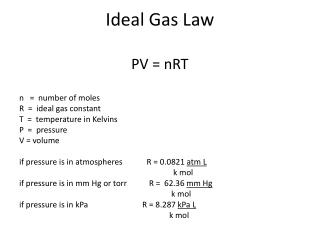
True or False and WHY? • The gas constant, R, is equal to 0.0821 when the pressure is expressed in kilopascals. • FALSE, pressure needs to be in atmopsheres.
True or False and WHY? • As more gas particles are added to a container, there are fewer collisions because the particles don’t go as far. • FALSE, there are more collisions because they are closer together.
True or False and WHY? • At a constant temperature, the pressure exerted by one mole of a gas decreases if the volume increases. • TRUE, P and V are inversely proportional.
True or False and WHY? • The ideal gas equation will only give correct values if the temperature is expressed in degrees Celsius. • FALSE, temp. in Kelvins
Which one-P,V, n, or T? • Kilopascals (kPa) • Pressure
Which one-P,V, n, or T? • mmHg • pressure
Which one-P,V, n, or T? • Moles • n
Which one-P,V, n, or T? • mL • volume
Which one-P,V, n, or T? • Atm • pressure
Which one-P,V, n, or T? • Grams • n-change grams to moles
Which one-P,V, n, or T? • oC • T-change to Kelvin
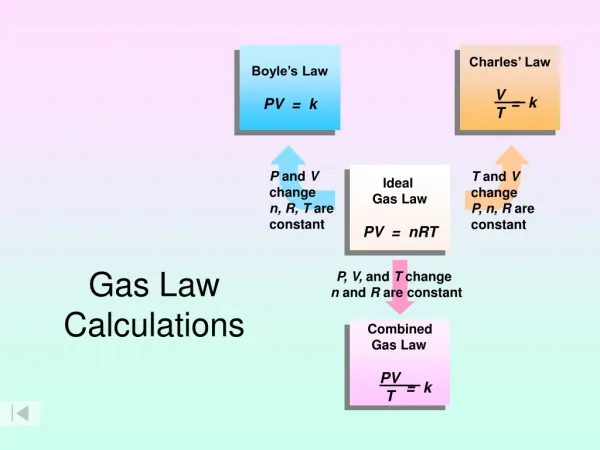
If I initially have a gas at a pressure of 12 atm, a volume of 23 liters, and a temperature of 200 K, and then I raise the pressure to 14 atm and increase the temperature to 300 K, what is the new volume of the gas? • 29.6 L
A gas takes up a volume of 17 liters, has a pressure of 2.3 atm, and a temperature of 299 K. If I raise the temperature to 350 K and lower the pressure to 1.5 atm, what is the new volume of the gas? • 30.5 L
If I have 2.9 L of gas at a pressure of 5 atm and a temperature of 50 0C, what will be the temperature of the gas if I decrease the volume of the gas to 2.4 L and decrease the pressure to 3 atm? • 160 K
If I have 17 liters of gas at a temperature of 67 0C and a pressure of 88.89 atm, what will be the pressure of the gas if I raise the temperature to 94 0C and decrease the volume to 12 liters? • 136 atm
If I have 4 moles of a gas at a pressure of 5.6 atm and a volume of 12 liters, what is the temperature? • 205 K
If I have an unknown quantity of gas at a pressure of 1.2 atm, a volume of 31 liters, and a temperature of 87 0C, how many moles of gas do I have? • 1.26 moles
If I contain 3 moles of gas in a container with a volume of 60 liters and at a temperature of 400 K, what is the pressure inside the container? • 1.64 atm
If I have 7.7 moles of gas at a pressure of 0.09 atm and at a temperature of 56 0C, what is the volume of the container that the gas is in? • 2310 L
If I have 0.275 moles of gas at a temperature of 75 K and a pressure of 1.75 atmospheres, what is the volume of the gas? • 0.97 L