Download
1 / 7
70 likes | 190 Vues
This document provides a comprehensive review of several stoichiometric and thermodynamic calculations involving gas behavior and reaction yields. It covers scenarios such as gas pressure calculations when oxygen and neon are mixed, and the oxidation of ethanol using potassium dichromate. Additionally, it explores the calculation of enthalpy changes in acid-base reactions and combustion reactions in calorimetry setups. The examples illustrate key concepts in gas laws, stoichiometric limiting reagents, theoretical yields, and heat changes in chemical processes.

E N D
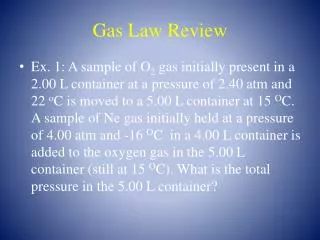
Gas Law Review • Ex. 1: A sample of O2 gas initially present in a 2.00 L container at a pressure of 2.40 atm and 22 oC is moved to a 5.00 L container at 15 OC. A sample of Ne gas initially held at a pressure of 4.00 atm and -16 OC in a 4.00 L container is added to the oxygen gas in the 5.00 L container (still at 15 OC). What is the total pressure in the 5.00 L container?
Stoichiometry Review • Ex. 2: Aqueous potassium dichromate, K2Cr2O7(aq), can oxidize ethanol to acetic acid in the presence of excess sulfuric acid The net ionic equation for this reaction is • 2 Cr2O72-(aq) + 3 CH3CH2OH(aq) + 16 H+(aq) → 3 CH3COOH(aq) + 4 Cr3+(aq) + 11 H2O(l) • (a) Identify the limiting reagent if 3.50 mL of pure ethanol, CH3CH2OH(l), are mixed with 48.0 mL of 1.00 mol.L-1K2Cr2O7(aq) and excess acid. The density of pure ethanol is 0.789 g.mL-1.
Stoichiometry Review • (b) What is the theoretical yield of acetic acid in moles and in grams? • (c) What is the % yield of acetic acid if 2.89 g of CH3COOH(l) was obtained after the product mixture had been purified?
Stoichiometry Review • Other stoichiometric complications: • 1. Impure starting materials. • 2. Starting material is a mixture. • 3. Gaseous products or reactants. • 4. Gases collected over water.
Calorimetry Review • Ex. 3 A 5.00 mL volume of a 0.60 M solution of phosphoric acid, H3PO4(aq), reacts with 45.00 mL of 0.25 M NaOH(aq) according to the reaction below. The temperature of the solution rises from 22.5 oC to 24.5 oC. Assuming the volumes of the solutions are additive, and the density of the final solution is 1.10 g mL–1, calculate the enthalpy change for the reaction. Assume the heat capacity of the solution is the same as water and the water produced by the reaction does not affect the volume of the resulting solution. • H3PO4(aq) + 3 NaOH(aq) Na3PO4(aq) + 3 H2O(l) Hrxn = ?
Calorimetry Review • Ex. 4:Nitrous oxide, N2O(g), reacts with carbon disulfide, CS2(g) according to the equation below. When performed in a constant volume bomb calorimeter with a heat capacity of 8.775 kJ ºC–1, the temperature of the calorimeter rises from 22.53 ºC to 29.13 ºC and forms 2.48 g of sulfur, S(s). Determine the internal energy change, ∆U, and the enthalpy change, ∆H of the following reaction at 25.0 °C. • 3 N2O(g) + CS2(l) 3 N2(g) + CO(g) + S(s)