Understanding Elements, Compounds, and Mixtures in Chemistry
This lesson delves into the fundamental concepts of elements, compounds, and mixtures. Students will explore definitions, characteristics, and distinctions among these categories of matter, including homogeneous and heterogeneous mixtures. Through collaborative discussions and peer editing, learners will analyze various examples and complete hands-on practice to reinforce their understanding. Emphasis will be placed on scientific method applications and proper lab reporting. Engage in this interactive session to deepen your knowledge of chemistry in the real world.

Understanding Elements, Compounds, and Mixtures in Chemistry
E N D
Presentation Transcript
Mixtures Agenda • Review • Yesterday’s homework • Notes on Mixtures • Homework
H Li Na K Be Mg Ca Sr Ba B Al Ga C Si Ge Sn Pb Element preparation
Element Quiz Put everything away Flip PT
Nitrogen, N Phosphorous, P Arsenic, As Oxygen, O Sulfur, S Selenium, Se Fluorine, F Chlorine, Cl Bromine, Br Iodine, I Next Elements
Physical or Chemical? • Egg cooking • You growing • Cutting grass
Compare homework with table partner. Questions?????
Peer Editing of Lab Reports Be tough – I will have no mercy!
Intro ___/10 Real world Funnels down Good flow Researched terms Ends with G’s hypo Materials and Methods ___/20 Good flow No I, me, we Research ___/20 Labeled table ½ Includes all data Clear/easy to understand Conclusions ___/20 Explains WHY phys/chem Relates back to hypo Opens back up to new real world Be tough!
Substances • An element is a substance that cannot be decomposed by any chemical reaction into simpler substances. All known elements listed on PT.
A compound is a substance composed of two or more elements chemically combined. Ex NaCl
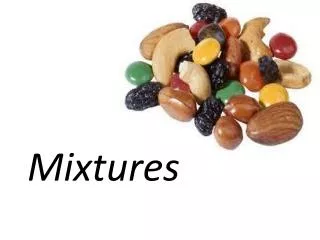
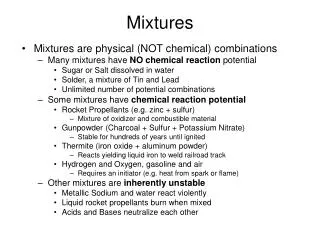
Mixtures • A mixture is a material that can be separated by physical means into two or more substances. The substances are simply mixed together – no reaction. • Ex. Iron + sulfur.
Talk with your table partner… • How are you going to tell the difference between an element and a compound?
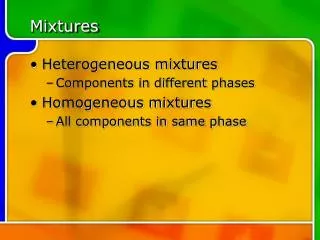
A homogeneous mixture is a mixture that is uniform in its properties throughout. (milk, lemonade, tap water)
A heterogeneous mixture is a mixture that consists of physically distinct parts, each with different properties. (granite, sulfur mixed with iron)
Talk with your row partner… • How are you going to tell the difference between a homogeneous mixture and a heterogeneous mixture?
Physically separable Chemically Separable
Mercury Salt – sodium chloride Water Air Snickers bar Kool-aid Element Compound Compound Homo mixture Hetero mixture Homo mixture Practice – with table partner E/C/Ho/He
Practice Time • Around the room are 16 bags filled with various types of matter. • After looking at the samples, determine which type of matter: E, C, Ho or He, it includes. • Record on the back of the sheet provided.
Salt water – Ho Hardware – He Zinc – E Rocks – He Distilled H2O– C Lead – E Sand - He Sugar - C Sugar H2O – Ho Silicon – E Baking soda – C Oil & H2O – He NaCl – C Calcium – E Glass – C Play dough - Ho ECM
Complete Homework • Element, compounds and mixture worksheet • Next group of elements • Lab report due Tuesday • Typed • On time • Proper format • NO EXCEPTIONS!