
Comprehensive Measurement Framework for Program Evaluation and Progress Monitoring in Early Education
This document outlines a structured measurement framework for evaluating and improving educational programs for children. It includes three levels: Level One focuses on program evaluation through observations, assessments, and stakeholder satisfaction to gauge the effect of interventions. Level Two emphasizes program planning by identifying strengths and needs of children through regular observations and assessments. Level Three details progress monitoring of individual children to track performance trends and adapt environments. These processes ensure effective intervention and support for diverse developmental needs.

Comprehensive Measurement Framework for Program Evaluation and Progress Monitoring in Early Education
E N D
Presentation Transcript
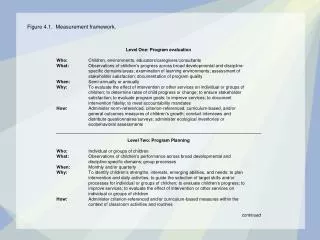
Figure 4.1. Measurement framework. Level One: Program evaluation Who: Children, environments, educators/caregivers/consultants What: Observations of children’s progress across broad developmental and discipline- specific domains/areas; examination of learning environments; assessment of stakeholder satisfaction; documentation of program quality When: Semi-annually or annually Why: To evaluate the effect of intervention or other services on individual or groups of children; to determine rates of child progress or change; to ensure stakeholder satisfaction; to evaluate program goals; to improve services; to document intervention fidelity; to meet accountability mandates How: Administer norm-referenced, criterion-referenced, curriculum-based, and/or general outcomes measures of children’s growth; conduct interviews and distribute questionnaires/surveys; administer ecological inventories or ecobehavioral assessments Level Two: Program Planning Who: Individual or groups of children What: Observations of children’s performance across broad developmental and discipline-specific domains; group processes When: Monthly and/or quarterly Why: To identify children’s strengths, interests, emerging abilities, and needs; to plan intervention and daily activities; to guide the selection of target skills and/or processes for individual or groups of children; to evaluate children’s progress; to improve services; to evaluate the effect of intervention or other services on individual or groups of children How: Administer criterion-referenced and/or curriculum-based measures within the context of classroom activities and routines continued
Figure 4.1. cont. Measurement framework. Level Three: Progress Monitoring Who: Individual children What: Observations of children’s performance on specific or individually targeted skills and/or processes (i.e., target behaviors) When: Daily and/or weekly Why: To discover trends and patterns in children’s performance; to guide adaptations of the social and physical environment; to ensure daily activities are a match to children’s developmental levels and needs; to monitor children’s progress over time; to evaluate the effect of intervention or other services on individual children How: Use a variety of methods including written descriptions, permanent products, and counts or tallies