Download
1 / 51
510 likes | 638 Vues
This overview explores the intricate process of protein synthesis, detailing how DNA is transcribed into mRNA, which facilitates the translation into polypeptides. Starting with DNA replication, we highlight key differences between DNA and RNA, including structure and error rates. We explain the roles of various RNA types in translation: mRNA carries the genetic code, tRNA serves as an adapter to bring amino acids, and rRNA forms the ribosome that catalyzes synthesis. This coordination underlies cellular function and the creation of essential proteins.

E N D
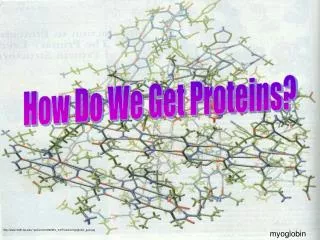
How Do We Get Proteins? http://www.math.fsu.edu/~quine/IntroMathBio_04/Proteins/myoglobin_geis.jpg myoglobin
When DNA copies….. • It copy's in a very specific order. It copies 5’-3’ from a 3’-5’ Template.
Nucleotides: basic molecule of DNA Pyrimidine
Pyrimidines and Purines Made up of a • Sugar (5 carbon) • Phosphate group • Nitric Base
DNA Replication • http://www.johnkyrk.com/DNAreplication.html
Differences between RNA and DNA • RNA has only a SINGLEStrand (DNA is Double Stranded) • RNA contains ribose instead of deoxyribose • RNA polymerase can start the RNA transcription without a primer
Differences between RNA and DNA • RNA uses Uracil(U) instead of Thymine(T) • More errors occur in an RNA copy than in DNA copy of nucleotides (103 more than in DNA) • FACT: DNA has a transcription error approximately every 107 nucleotides. RNA has an error approximately every 104 !
Differences between RNA and DNA • WHY are there more errors in RNA Transcription? • One of several reasons is that in rare instances Uracil can also bond with Guanine
Is this a Bad thing? • WHY are there more errors in RNA Transcription? • One of several reasons is that in rare instance Uracil can also bond with Guanine • RNA is a temporary copy in Eukaryotes
Types of RNA mRNA • mRNA= messenger RNA • codes for a protein
Types of RNA tRNA • tRNA= transfer RNA • central to protein synthesis as adaptors between mRNA and amino acids
Types of RNA rRNA • rRNA= ribosomal RNA • form the basic structure of the ribosome and catalyze protein synthesis
Transcription- the synthesis of RNA under DNA (occurs in the nucleus) • Translation- the actual synthesis of a polypeptide coded for by the mRNA. (changing the base sequence of the mRNA molecule into a chain of amino acids that form a polypeptide. For our purposes a protein.)
The DNA strand from which the mRNA is copied is the TEMPLATE STRAND
The mRNA leaves the nucleus and enters a ribosome (made up of rRNA)
tRNA collects a specific amino acids present in the cell and brings it to the ribosome
The anticodon of the tRNA matches up with its counterpart codon on the mRNA
When the mRNA & the tRNA link up the amino acid detaches and is connected to the adjacent amino acid
rRNA Ribosome
rRNA mRNA enters the “A” site of the ribosome
rRNA When the first codon reaches the “P” site the tRNA brings down the amino acid and links up with the mRNA
rRNA The “E” site is where the amino acid separates form the tRNA and links up to adjacent amino acids. This is where the MRNA and tRNA leave the ribosome
ANTICODONS tRNA • Anticodons specify which amino acid a tRNA collects • The anticodon then pairs up with its corresponding codon Anticodon
ANTICODONS tRNA • So for example... • The anticodon AGU would pair with the codon UCA. • THEY ARE OPPOSITES OF EACH OTHER Anticodon
So What's a codon? Codon • This basic unit of genetic code is 3 nucleotides long • It specifies a specific amino acid • Each codon only specifies 1 amino acid (BUT…an amino acid may have several different codons that code for it)
http://images.google.com/imgres?imgurl=http://biology.kenyon.edu/courses/biol114/Chap05/trna-1.gif&imgrefurl=http://biology.kenyon.edu/courses/biol114/Chap05/Chapter05.html&h=382&w=283&sz=37&tbnid=G8z7JoxTdy0J:&tbnh=119&tbnw=88&hl=en&start=5&prev=/images%3Fq%3DtRNA%26svnum%3D50%26hl%3Den%26lr%3D%26client%3Dfirefox-a%26rls%3Dorg.mozilla:en-US:official_s%26sa%3DGhttp://images.google.com/imgres?imgurl=http://biology.kenyon.edu/courses/biol114/Chap05/trna-1.gif&imgrefurl=http://biology.kenyon.edu/courses/biol114/Chap05/Chapter05.html&h=382&w=283&sz=37&tbnid=G8z7JoxTdy0J:&tbnh=119&tbnw=88&hl=en&start=5&prev=/images%3Fq%3DtRNA%26svnum%3D50%26hl%3Den%26lr%3D%26client%3Dfirefox-a%26rls%3Dorg.mozilla:en-US:official_s%26sa%3DG
THE END http://www.chemistry.emory.edu/faculty/lynn/research/dna/template.gif
When DNA copies….. • It copy's in a very specific order. It copies 5’-3’ from a 3’-5’ Template.