Injury Severity Analysis of Older Drivers in Iowa: Contributory Factors and LiDAR Insights
This exploratory study investigates the factors influencing injury severity among older drivers in Iowa. Key objectives include identifying driver, environmental, weather, and policy factors that contribute to crash outcomes. An Ordered Probit Model is developed to guide future research directions. Findings indicate that age, gender, rural environments, and specific roadway characteristics impact injury severity. Additionally, the study leverages LiDAR technology to assess roadway conditions and detect obstructions at intersections, enhancing safety for older drivers.

Injury Severity Analysis of Older Drivers in Iowa: Contributory Factors and LiDAR Insights
E N D
Presentation Transcript
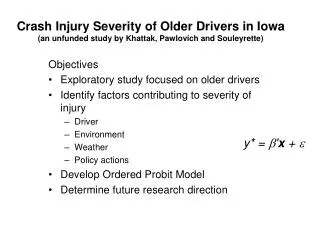
Crash Injury Severity of Older Drivers in Iowa (an unfunded study by Khattak, Pawlovich and Souleyrette) Objectives • Exploratory study focused on older drivers • Identify factors contributing to severity of injury • Driver • Environment • Weather • Policy actions • Develop Ordered Probit Model • Determine future research direction y* = 'x +
Roadway Characteristics Geometry Pavement type & condition Speed limit Policy Factors Speed limit changes Enforcement Environmental & Temporal Factors Weather Light condition Urban or rural location Year, month, day of week Driver Characteristics Age, Gender Alcohol/drug use Use of safety restraint equip Driving behavior Single-Veh Crash Injury Severity Crash Characteristics Crash type Degree of vehicle damage Vehicle Characteristics Vehicle type Problem conceptualization
Conclusions: Contributory factors • Age, gender • Farm vehicles • Curves in level terrain • Fixed objects hit; overturned • Rural environment No evidence of increased injury due to NMSL
An Application of LiDAR Technology to Highway Safety (An MTC funded study by Khattak, Hallmark and Souleyrette) Objective Utilize LiDAR data to obtain information that can lead to geometric safety improvements at highway intersections for older drivers
Research Methodology Accident Data LiDAR Data Orthophotos Geocode Geocode Data Integration in GIS Conduct in-office analysis Field validation of results
Conclusions • Correctly identified obstructions at intersection with the most accidents involving older drivers • LiDAR data can be effectively used for detection of obstructions at intersections • Chances of detecting obstructions that do not exist & missing obstructions that do exist are reasonably low • Both first-return and last-return data should be utilized • Intersections where obstructions are detected may then be field inspected