Download
1 / 5
50 likes | 174 Vues
Explore the tumultuous period of the First Red Scare in the United States, marked by fear of communism after World War I. Discover how Bolshevik actions and communist uprisings in Europe fueled American paranoia, leading to labor unrest, strikes, and government crackdowns. Key events include the Seattle shipyard strike and the infamous Palmer Raids, where thousands were arrested and deported. Also, understand the resurgence of the Ku Klux Klan and patriotic organizations during this era. This history reveals the complexities of extremism from both left and right.

E N D
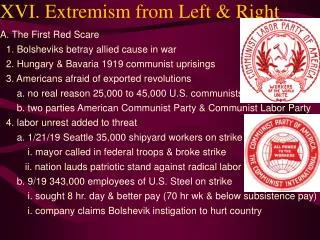
XVI. Extremism from Left & Right A. The First Red Scare 1. Bolsheviks betray allied cause in war 2. Hungary & Bavaria 1919 communist uprisings 3. Americans afraid of exported revolutions a. no real reason 25,000 to 45,000 U.S. communists b. two parties American Communist Party & Communist Labor Party 4. labor unrest added to threat a. 1/21/19 Seattle 35,000 shipyard workers on strike i. mayor called in federal troops & broke strike ii. nation lauds patriotic stand against radical labor b. 9/19 343,000 employees of U.S. Steel on strike i. sought 8 hr. day & better pay (70 hr wk & below subsistence pay) i. company claims Bolshevik instigation to hurt country
2 ii. hired strike breakers, provoked riots, broke up meetings iii. propaganda worked issues of decent wages & hours ignored c. Boston Police also went on strike at same time i. Newspapers claim it is Bolsheviks as well ii. Veterans & Harvard students volunteered iii. government replaced all striking police force iv. Gompers asked Gov. to reinstate police v. Coolidge says no one had right to strike against public safety d. papers associate strike with Communism 5. A few radicals want to start a revolution a. attempted assassinations using bombs b. Bomb exploded on porch of Attorney General A. Mitchell Palmer c. Palmer was now convinced of a "Red Menace" i. launches a series of raids in several cities ii. arrested over 5,000 accused communists
iii. encouraged fear of Eastern Europeans 600 deported 6. Nicola Sacco & Bartolomeo Vanzetti arrested in 1920 a. murder guard in robbery of shoe factory b. Mass. death on circumstantial evidence c. convicted anarchism, foreign appearance d. Intellectuals rallied to their defense i. appealed to governor of Mass. ii. commission reexamines evidence iii. reaffirmed verdict 8/23/1923 executed men iv. 50 yrs. later Gov. Michael Dukakis exonerated them 7. "Red Scare" declines after 1920 only a few persecutions 8. Patriotic organizations start as result of scare a. American Legion, American Defense Society, Sentinels of the Republic, The United States Flag Association & the Daughters of the American Revolution 3
4 b. gave purpose and support to many Americans c. supported American traditional values & attacked communists B. Threat from the Right 1. The Birth of A Nation produced by D.W.Griffith 1915 a. based on The Clansman an historic romance of the Ku Klux Klan b. written by Tomas Dixon Jr. 1905 c. protested everywhere 2. the Rebirth of the Ku Klux Klan ( Fall 1915) a. William J. Simmons, lay preacher & salesman b. rebirth of old anti-Black Reconstruction group c. As Imperial Wizard he changed organization i. opposed Blacks, Jews, liberals, Catholics, Immigrants & anyone
5 d. grew slowly but enticed returning veterans after the war i. blamed immigrants & Blacks for unemployment & bad times ii. grew in almost every city responding to Great Migration iii. at peak in 1923 several million members iv. some areas purely fraternal organization v. influenced politics in OR, OK, IN, LO & TE