Download
1 / 2
20 likes | 168 Vues
This research project led by Judith C. Yang at the University of Pittsburgh focuses on the innovative production of one-dimensional (1D) nanostructures and heterostructures, particularly SiC Y-junctions, using a metal-catalyzed vapor-liquid-solid mechanism. Through controlled metal catalyst release and agglomeration, unusual 1D nanostructures are formed, gaining insights into the catalytic processes involved. This understanding is essential for developing nanoscale devices with tailored architectures and functionalities. The project also emphasizes outreach to underrepresented groups in STEM through hands-on workshops and research experiences.

E N D
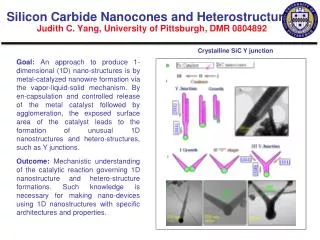
Silicon Carbide Nanocones and HeterostructuresJudith C. Yang, University of Pittsburgh, DMR 0804892 Crystalline SiC Y junction Goal: An approach to produce 1-dimensional (1D) nano-structures is by metal-catalyzed nanowire formation via the vapor-liquid-solid mechanism. By en-capsulation and controlled release of the metal catalyst followed by agglomeration, the exposed surface area of the catalyst leads to the formation of unusual 1D nanostructures and hetero-structures, such as Y junctions. Outcome: Mechanistic understanding of the catalytic reaction governing 1D nanostructure and hetero-structure formations. Such knowledge is necessary for making nano-devices using 1D nanostructures with specific architectures and properties.
Silicon Carbide Nanocones and HeterostructuresJudith C. Yang, University of Pittsburgh, DMR 0804892 Research Experience: Post-doctoral: This grant provides the support for one post-doctoral research associate: Dr. Zhenyu Liu High School Outreach: Figure: 2nd annual PJAS and PECAP “Visualization of Nanotechnololgy” workshop. U. Pittsburgh. 10/11/08 The PI participates in the annual Pennsylvania Junior Academy of Science (PJAS) workshop where local high school students visit the the Nanofacility at U. Pittsburgh for hands-on demonstrations for a day, including electron microscopy. The recent PJAS includes Pitt Engineering Career Access Program (PECAP) students. PECAP is a U. Pittsburgh program to recruit, retain and students from under-represented groups in the STEM fields. Undergraduate Research Experience: This grant provides the support one female undergraduate student for summer research projec on C nanotubes: Ms. Kelsey Finegan (5/09- 8/09) Kelsey Finegan Zhenyu Liu