Qualifying purposes
This guide explains the qualifying purposes for organizations seeking a welfare exemption in California. Eligible entities include religious, charitable, educational, scientific organizations, and more, provided they meet certain IRS and state tax board criteria. Non-profits must use their property exclusively for qualified activities and navigate a two-part application process through the Board of Equalization and local county assessors. Learn about the necessary organizational requirements, tax-exempt statuses, and the importance of incorporation language to secure the welfare exemption.

Qualifying purposes
E N D
Presentation Transcript
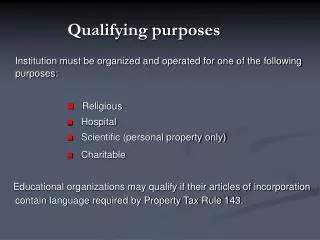
Qualifying purposes Institution must be organized and operated for one of the following purposes: Religious Hospital Scientific (personal property only) Charitable Educational organizations may qualify if their articles of incorporation contain language required by Property Tax Rule 143.
Religious Organizations Charities Museums Theaters Zoological Associations Open-Space Preservation Organizations Organizations involved with Rehabilitation Hospitals Clinics Low-Income Housing Non-Profit Schools Historical Associations …and others! Who Files the Welfare Exemption?
Eligibility • Non-profit organizations and Limited Liability Companies with non-profit members • Organized for religious, hospital, scientific or charitable purposes • Must have the following tax-exempt status: Internal Revenue Service 501(c)(3) or California Franchise Tax Board 23701(d) • Property must be used exclusively for qualified exempt activity
Two-Part Process Non-profit organization applies with: • The Board of Equalization for an Organizational Clearance Certificate (OCC) and • Local County Assessor for the Welfare Exemption Claim