Qualifying
Understanding how to qualify a claim is essential in crafting compelling arguments. To "qualify" means to limit or modify a statement, allowing for nuances and exceptions in your reasoning. This method involves taking a stance while recognizing limitations—such as time frames, comparisons, or specific conditions. Explore how to effectively defend, challenge, or qualify claims using well-crafted qualifiers. By mastering this technique, you can broaden the scope of your arguments and enhance persuasive communication in discussions ranging from educational policies to campaign finance.


Qualifying
E N D
Presentation Transcript
Qualifying A sneaky method to having it all!
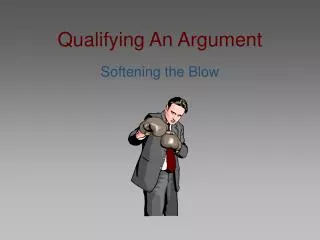
What does it mean to “qualify”? • The prompt asks you to “defend, challenge or qualify the claim” • Qualify--to limit or modify the claim • When you qualify, you take a stance on a particular side of an argument, but allow for a concession or loophole. • The prompt asks you to “defend, challenge or qualify the claim” • Qualify--to limit or modify the claim
How to Qualify: In order to “qualify” an argument, you might tweak the original statement a bit in order to be able to defend it. Words that qualify: Except Although However If…than (causality—if a particular condition is met; if A then B) Other? • You could: • Give a specific time frame • An further description • A condition
Defend, Challenge or Qualify: Ms. K is a fine dresser. • Qualifications: • Ms. K is a fine dresser on Mondays and Fridays only. (Specific time frame) • Ms K. is a fine dresser when compared to her colleagues. (Further description) • Ms. K. is a fine dresser if you consider Hammer Pants to be fashionable. (A condition) • What is the benefit to qualifying? • Any drawbacks?
Now you try: American schools should be segregated by gender. • Develop four claims: • Defend • Challenge • Qualify in two different ways
Before we get started with our argument session: • Qualify today’s topic: Campaign contributions should be allowed.