Understanding the Big Bang Theory and the Scientific Method
This article explores the Big Bang Theory, which posits that the universe originated from a dense sphere of hydrogen about 15 billion years ago. It discusses how this mass exploded, leading to the formation of galaxies as particles condensed due to gravity. Additionally, the piece outlines the steps in the scientific method: stating a problem, gathering information, forming a hypothesis, conducting controlled experiments, and proposing theories based on evidence. It emphasizes the importance of testing hypotheses for verification and understanding scientific principles.

Understanding the Big Bang Theory and the Scientific Method
E N D
Presentation Transcript
Hypothesis • An informed guess that tries to explain how or why an event occurs. • A good hypothesis explains known facts. • What is one hypothesis that explains the origins of the galaxies?
Big Bang Hypothesis • Originally the universe was packed into one dense sphere of hydrogen, probably not much larger than our sun. • About 15 billion years ago this mass of hydrogen exploded, forming a gigantic expanding cloud. • Some parts of the cloud moved faster than others, but all parts moved outwards, away from the center.
Big Bang (cont.) • As the clouds moved, the particles condensed into billions of galaxies. • They all continued to move outward, away from the center and each other. • Those moving at the fastest speeds are now farthest out in space.
Gravity • The force of gravity is directly related to the mass of the objects and how close they are to each other. • Mass – the amount of matter (stuff) in an object or substance. • Weight – the effect of gravity on an object or substance.
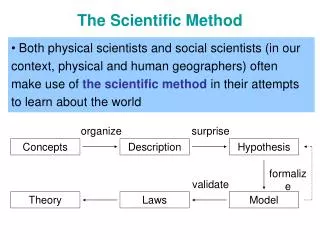
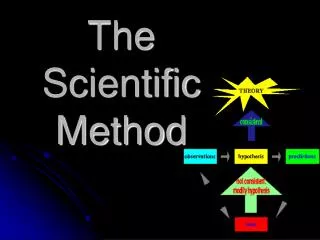
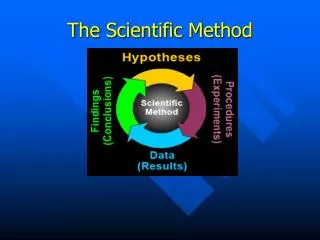
Steps in the Scientific Method • State the Problem • What am I trying to figure out? • Gather Information • Find out what is already known by research and observation • Make a Hypothesis • Propose a solution based on your information • An educated guess about the relationship between the variables you will be testing
Variables - factors that change • Perform a Controlled Experiment or Collect Field Data • Independent Variable – the variable that is purposefully changed by the experimenter • Dependent Variable – the variable that responds to the change (the outcome) • Constants – all factors that remain the same and have a fixed value in an experiment • Control - a duplicate setup of the experiment you are performing with everything identical except for the variable that you are testing • Confounding variable – variables that the researcher failed to control, or eliminate, damaging the validity of an experiment
Perform a Controlled Experiment or Collect Field Data • Data • Information from experiments, measurement, research and observation
Propose a Theory • Accepted hypothesis based on evidence • Test • Again and again and publish so that: • Others may verify results