Download
1 / 5
50 likes | 162 Vues
This resource focuses on fundamental concepts in mathematics, including the multiplication of numbers in scientific notation, the identification of irrational numbers, and conversions to standard and scientific forms. Students will practice multiplying and dividing numbers in scientific notation, understanding the nature of irrational numbers, and rounding decimals to specified precision. The exercises provided involve real-world examples, such as calculating the difference between quantities in a natural history museum, enhancing comprehension and application skills in mathematics.

E N D
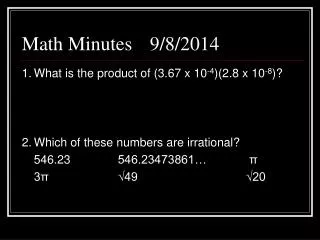
Math Minutes 9/8/2014 1. What is the product of (3.67 x 10⁻⁴)(2.8 x 10⁻⁸)? 2. Which of these numbers are irrational? 546.23 546.23473861… π 3π √49 √20
Math Minutes 9/9/2014 1. Convert these to standard form. • 6.08 x 10⁴ • 7.777 x 10⁻⁸ 2.Which of these numbers cannot be irrational? √45 √220 √56 √256 √2 √1 3. Round 7.848 to the nearest hundredths.
Math Minutes 9/10/2014 1. Which one of these numbers is irrational and why? ¾ 118/117 π/10 4π/2π • Convert these numbers to scientific notation. A. 7,230,000 B. 0.00678
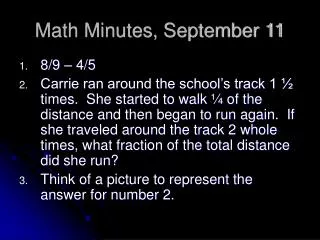
Math Minutes 9/11/2014 The Florida Museum of Natural History has 2.45 x 10⁴ bird skeletons and 1.04 x 10⁴ bird eggs. How many more bird skeletons than bird eggs are there at the museum? • 141 • 1,410 • 14,100 • 141,000
1. Find the product. (1.123 x 10²¹)(9.9 x 10⁻¹⁰) 2. Find the quotient 8.77 x 10¹¹ 5 x 10⁶ Math Minutes 9/12/2014 3. Put these in order from least to greatest. 1.2 x 10⁶ 1.2 x 10³ 1.2 x 10¹¹ 2.1 x 10³ 2.1 x 10⁹