Understanding CPU Scheduling: Concepts, Criteria, and Algorithms in Operating Systems
This overview of CPU scheduling in operating systems explains how the CPU switches between processes to enhance system productivity. It discusses key concepts like CPU-I/O burst cycles, the roles of short-term schedulers, and the significance of the ready queue. The factors influencing CPU scheduling decisions, including preemptive and non-preemptive strategies, are outlined. Additionally, it examines various scheduling criteria such as CPU utilization, throughput, and waiting time, along with popular algorithms like FCFS, SJF, and Round-Robin for effective process management.

Understanding CPU Scheduling: Concepts, Criteria, and Algorithms in Operating Systems
E N D
Presentation Transcript
CPU Scheduling CSCI 4534
Introduction • By switching the CPU among processes, the O.S. can make the system more productive • Some process is running at all times • Several processes are kept in memory • A process is executed until it must wait • typically for I/O • When this process waits, another runs • running means the CPU is executing it
CPU-I/O Burst Cycle • Observed Property of Processes: • Processesalternate between a cycle of CPU execution and I/O wait • CPU burst • I/O burst (read from file/write to file) • CPU burst • … • CPU burst (to terminate)
CPU-I/O Burst Cycle • Durations of CPU bursts vary, but curve is similar to Figure 5.2 histogram, typically: • large number of short CPU bursts • small number of long CPU bursts • I/O bound programs have many short CPU bursts • CPU bound programs have a few long CPU bursts
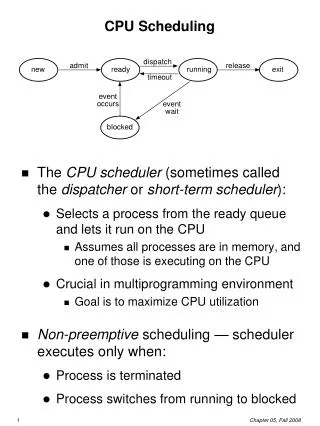
CPU Scheduler • When CPU is idle, the O.S. selects a process in the ready queue • Done by short-term scheduler / CPU scheduler • Ready Queue is set of PCBs in: • FIFO queue • priority queue (actually a Ready State, not queue) • tree • unordered linked list
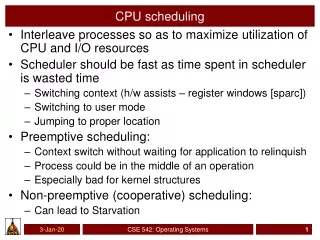
CPU Scheduling Decisions • CPU scheduling decisions are made when: • A process switches from running to waiting • A process switches from running to ready • A process switches from waiting to ready • A process terminates • What is preemptive? • What are problems? • What is nonpreemptive?
Dispatcher • The dispatcher gives control of CPU to the process selected by short-term scheduler • It does context switching • It switches to user mode • It jumps to next executable statement in the user program • The time taken to stop one process and start another is dispatch latency • “interval between stimulation and response”
Scheduling Criteria • CPU utilization • Throughput - # processes completed per time unit • Turnaround time - time from submission to completion • Waiting time - in the ready queue • Response time - time from submission to first response
Scheduling Criteria • Goals: • Maximize: CPU Utilization and Throughput • Minimize: Turnaround, Waiting and Response Times • May also want to minimize variance for response time for more predictability
Scheduling Algorithms • FCFS • SJF • Priority Scheduling • Round-Robin • Multilevel Queue • Multilevel Feedback Queue