Addressing Ocean Acidification: An International Network for Marine Ecosystem Research
210 likes | 343 Vues
The International Network from Feely et al. (2010) highlights the urgent need to address ocean acidification, a multifaceted issue exacerbated by anthropogenic CO2 uptake. Since 1850, ocean pH has decreased significantly, projecting a 0.4 decrease by 2100. Current acidity levels are 30% higher, threatening marine ecosystems. This network aims to monitor CO2 levels and associated biological effects through an integrated system of observations, contributing to better management of fisheries and understanding ecological impacts along coastal and open ocean regions.


Addressing Ocean Acidification: An International Network for Marine Ecosystem Research
E N D
Presentation Transcript
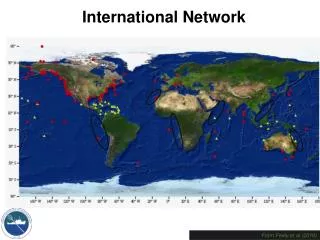
International Network From Feely et al (2010)
Ocean Acidification Becomes Warming’s ‘Evil Twin’ at COP15 Photos: Scripps Oceanography
CO2 and pH “time series” datafrom North Pacific Ocean From R. Feely & D. Keeling
Ocean Acidification • Since about 1850, the CO2 chemistry of the oceans has been changing because of the uptake of anthropogenic CO2 by the oceans. • Decrease in pH of about 0.1 over the last two centuries; a projected decrease of 0.4 by 2100 • Today’s ocean has undergone a 30% increase in acidity and a decrease in carbonate ion concentration of about 20% • These changes in pH and carbonate chemistry may have profound impacts on many open ocean and coastal marine ecosystems. Photo: Missouri Botanical Gardens http://www.biol.tsukuba.ac.jp/~inouye Coral Calcareous Plankton
pH CO32- CO2(aq) Brewer (1997) CO2-induced seawater acidification: Simple chemistry Skirrow & Whitfield (1975) Wolf-Gladrow, Riebesell, Burkhardt, Bijma (1999)
Calcification/carbonatedissolution Saturation State [ ] [ ] + - 2 2 Ca CO W 3 = phase * K sp , phase W > = 1 precipitation W = = 1 equilibrium W < = 1 dissolution Ca2+ + CO32- CaCO3 Ω>1 Ca2+ + CO32- CaCO3 Ω<1
A Path Forward • We know enough to act: reduce CO2 • To know precisely which commercial fisheries (& marine ecosystems) will be affected first… • International measurement network: CO2 as function of time and depth, available for all • Corals • high latitudes, coastal, & open ocean • Communal facilities for live organism studies • Integrated Modeling “from CO2 to fish”
An International Network From Feely et al (2010)
‘Baja to BC” Test bed • The groups already cooperate • “Baja to BC” West Coast is one example which urgently needs ocean acidification observing system • CO2 observations will tell us where & when to look for biological effects • Community experimental facility to test impacts on commercially & ecologically important species
In-Situ Measurements from Fixed Moorings Images: Uwe Send
The power of CCE1/2 comes from the context of other measurements California Current Ecosystem (CCE) moorings - Ships sample many variables and provide ground truth - Gliders provide cross-shelf sampling with a few variables - Moorings give full time sampling, wide range of variables CCE-2(SIO/SWFSC/PMEL) CCE-1(SIO/SWFSC/PMEL) CalCOFI/ LTER Pt.Conception Chlorophyllshown on surface;salinity on cross-section Gliders(CORC, LTER, Moore) CalCOFI line 80
Question: Why do we think we can create a regional then global network?Answer: The oceanographic community has already built a network of 3000+ robots for temperature and salinity over last 12 years: Argo
Robot Positions 03 Dec 2010 26 nations contribute; data available to all www.argo.ucsd.edu
ROBOTS Depth Temperature Salinity Need to be Extended to Dissolved Gasses & biology Argo Floats Davis and Roemmich with a float “robot” A profiling Argo float
Ocean Temperature Increase: measured 0-700m NAtl SAtl Red=Observed Blue=Model average SPac NPac NInd Sind 1940 2000
A Lesson from Argo • One proven route to an operational International network • 1. Scientists do it first • 2. Collect the data to “make the case” • 3. Agencies and formal structures use that case to complete the network & make it “sustained” • 4. “Light touch” open network structure survives the transition (much to the delight of scientists..)