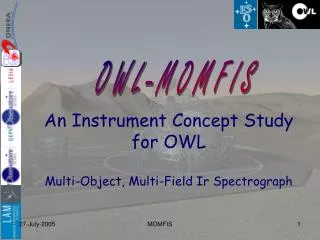
OWL IR MOS study
This study led by Jean-Gabriel Cuby and a team from Marseille, Lyon, and Meudon focuses on the search for reionization at redshifts z=8-19 using Lyα observations in the J to K bands. It investigates approximately 100 AGN and quasars across the OWL field and aims to study the Orion region at z=3, analyzing chemical abundances and gradients. The use of an IR Multi-Object Spectrograph (MOS) is pivotal to detect these celestial bodies effectively, achieving a Strehl ratio greater than 80% at K over a field of 5 arcminutes, presenting a significant instrumentation challenge.

OWL IR MOS study
E N D
Presentation Transcript
OWL IR MOS study Study lead : Jean-Gabriel Cuby LAM (Marseille), CRAL (Lyon), OPM (Meudon), ONERA ESO: M.Casali
Search for Reionization at z=8-19 Ly α in J to K IR ~ 100 AGN/Quasars per OWL field MOS Detect Orion at Z=3 abundances/gradients IFU 1. Why an IR MOS ?
2. Field information MCAO Strehl>80% at K over 5 arcminutes TelescopeRes elements/field OWL 7 x 10⁸ at K Schmidt plate 5 x 10⁸ massive instrumentation challenge to use the photons gathered