
Ecosystems
E N D
Presentation Transcript
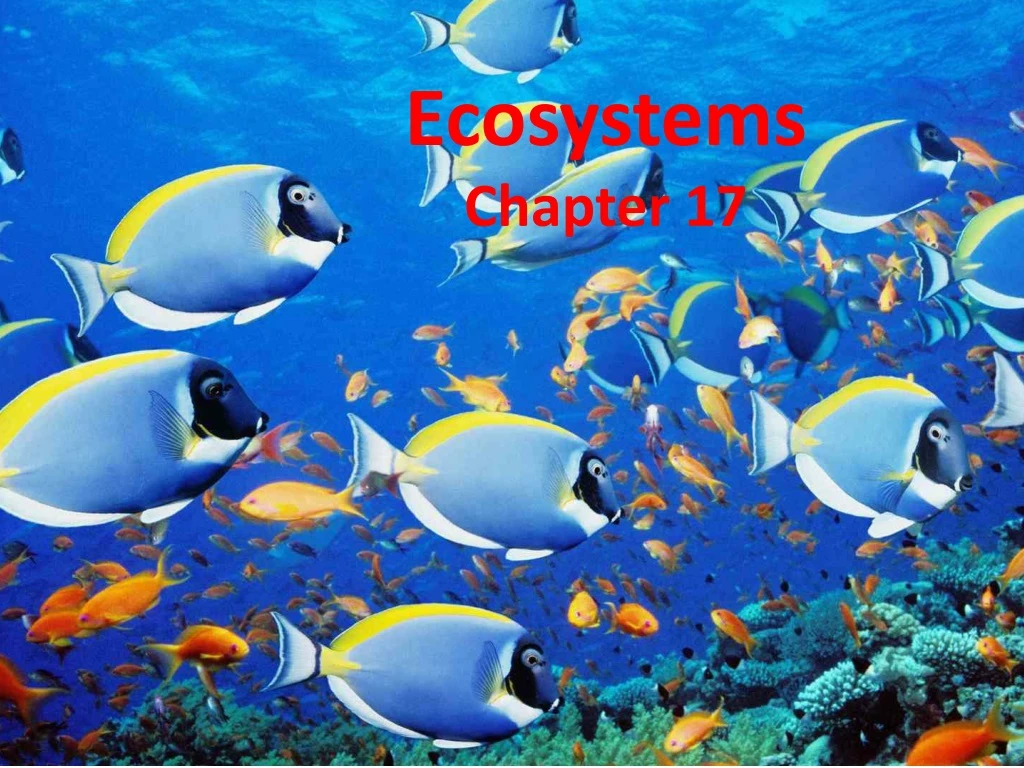
Ecosystems Chapter 17
Section 17-1 What is an ecosystem?
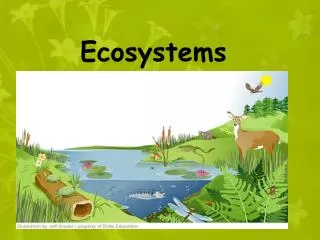
Organisms Interact with Each Other • Ecology is the study of the interactions of living organisms with one another and their environment • A habitat is the place where a population lives • A community is the many different species that live together in a habitat
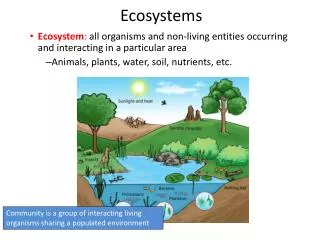
Organisms Interact with Each Other • An ecosystem consists of a community and all the physical aspects of its habitat like soil, water and weather • The physical aspects of the habitat are abiotic factors (non-living) • The living organisms in a habitat are biotic factors
Ecosystems support diverse communities The number of species living within an ecosystem is a measure of its biodiversity
Ecosystem inhabitants • Includes all of the large animals, small animals, trees, soil, water, insects and so on
Ecosystems Change over time • The first organisms to live in a new habitat are small fast growing plants called pioneer species
Succession • A somewhat regular progression of species replacement is succession • Primary succession occurs where plants have not grown before • Secondary succession occurs in areas where there has been previous growth
Section 17-2 Energy flow in ecosystems
Primary Energy Source • Most life on earth depends on photosynthetic organisms • Why? • They capture sunlight and store it as chemical energy!
Primary Energy Source cont… • Primary productivity is the rate at which organic material is produced by photosynthetic organisms • Primary productivity determines the amount of energy available in an ecosystem
Primary Energy Source cont… • Producers, like plants, are organisms that first capture energy (sunlight) • Consumers are organisms that consume organisms to obtain energy
Trophic Levels • Ecologists study how energy moves through an ecosystem by assigning organisms to a specific level or trophic level • The level is determined by the organisms source of energy
Trophic Levels cont… • The path of energy through the trophic levels of an ecosystem is called a food chain
Trophic Levels cont… • Producers are the lowest level • Herbivores are on the second level and called primary consumers • Secondary consumers are carnivores and omnivores • Tertiary consumers are carnivores that eat other carnivores
Trophic Levels • Detrivores are organisms that get energy from organic waste • Bacteria and fungi are called decomposers because they cause decay
Food Web • In ecosystems, energy does not follow a straight path because man animals feed at different trophic levels • This causes an interconnected group of food chains called a food web
Energy Transfer • Energy is lost within the ecosystem as heat • It is not a useful source of energy in ecosystems • As we move up the trophic levels, the energy store by the organism is 1/10th of the energy stored by the previous level
Pyramid of Energy • An energy pyramid is a diagram in which each trophic level is represented by a block, stacked one on top of the other
Section 17-3 Ecosystems cycle materials
Materials Cycle between Living and Non-Living Things • Water, carbon, nitrogen and phosphorus pass from the nonliving environment to living organisms and back to nonliving environment • That cycle is called a biogeochemical cycle
Water Cycle is Driven by the Sun • Water has the greatest influence on an ecosystem • Water vapor condenses, rains, seeps into the Earth and becomes ground water • Water is heated by the sun, evaporates and reenters the atmosphere
The Carbon Cycle is Linked to Energy • Respiration: Organisms use oxygen and produce CO2 • Combustion: Carbon returns to the air through combustion or burning • Erosion: Marine organisms use CO2 to make shells. Shells become sediment and as the sediments erode, carbon is made available
Plants and Bacteria use Nitrogen and Phosphorus • Nitrogen and phosphorus build proteins and nucleic acids • Phosphorus is part of ATP • The atmosphere is 79% Nitrogen • Nitrogen fixing bacteria (combine H and N to form ammonia) live in the soil
Nitrogen Cycle • Assimilation or absorption of nitrogen into plant and animal compounds • Ammonification is the production of ammonia by bacteria during decay • Nitrification is the production of nitrate from ammonia • Denitrification is the conversion of nitrate to Nitrogen gas
Sustainable Agriculture • The growth of plants is limited by the availability of nitrogen in the soil • Decomposers return mineral nutrients to the soil, however crops are harvested and nutrients were lost • Sustainable Ag is farming that remains productive, profitable and replenishes the soils nutrients, reduces erosion and controls weeds and pests
Sustainable Agriculture • Farmers will plant cover crops after harvest to keep the soil from eroding away, store water and provide nutrients to bacteria and insects after being plowed under • Farmers will rotate their cattle and sheep in several pastures to prevent overgrazing