Ecological Relationships
650 likes | 2.57k Vues
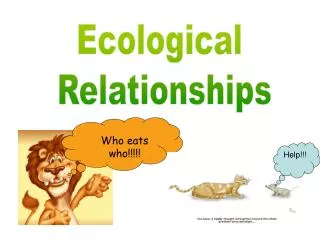
Ecological Relationships. Who eats who!!!!!. Help!!!. Objectives. Today I will learn: The important physical factors in the environment of animals and plants How plants and animals differ due to their environment (Adaptation) How to identify producers primary consumers and predators


Ecological Relationships
E N D
Presentation Transcript
Ecological Relationships Who eats who!!!!! Help!!!
Objectives Today I will learn: • The important physical factors in the environment of animals and plants • How plants and animals differ due to their environment (Adaptation) • How to identify producers primary consumers and predators • How to sort ‘classify’ animals into groups
Objectives In today’s lesson I will also learn: • About the different habitats organisms live in. • How to describe the environment of different habitats. • About the special adaptations that organisms have to help them live in their habitat.
Key words • Habitat • Environment • Adapted • Adaptation • Producer • Consumer • Predator
What needs does an animal have??? Just give me a carrot Raw Meat sounds good
What needs does a plant have???
Habitats • What is a habitat? • The place where an organism lives is called a habitat.
Remember Different organisms live in different habitats.Can you name some organisms for each of the habitats?
Environment • The word environment is used to describe what a habitat is like. .
Adaptations • Adaptations are features which organisms have that help them survive in their habitat I would call my environment
So what lives here?? This place was a bit too…………………….
A camels habitat is a desert Hot, Dry but at least you don’t get bothered by people
Adaptations: They are desert animals and have numerous adaptations for life in an arid habitat. • The hump stores fat, which they are able to draw upon for water. • They have webbed feet (to prevent sinking in the sand); • They can close their nostrils and they have a double row of eyelashes to keep out the sand. • They can endure long periods without drinking - up to 17 days. • When they do drink, they can take up to 136 litres (30 gallons) at a time. By producing dry faeces and little urine, they can conserve water. • Their body temperature can rise 6-8 degree Celsius before sweating.
So what if I don’t have any leaves!!! Apart from the camels this place is great!!
It’s the right temperature and no-one but no-one messes with me I do
And last ....... Who eats who??
We do But who eats us??
And last ....... There is nothing like a Sunday joint of human!!!
Rate your Understanding I think I am an expert I think I have a good idea I think I have got some of it ? Help – can you go through it again
Objectives Today I have learned: • The important physical factors in the environment of animals and plants • How plants and animals differ due to their environment (Adaptation) • How to identify producers primary consumers and predators • How to sort ‘classify’ animals into groups
Objectives In today’s lesson I have also learned: • About the different habitats organisms live in. • How to describe the environment of different habitats. • About the special adaptations that organisms have to help them live in their habitat.
Rate your Understanding I think I am an expert I think I have a good idea I think I have got some of it ? Help – can you go through it again
This powerpoint was kindly donated to www.worldofteaching.com http://www.worldofteaching.com is home to over a thousand powerpoints submitted by teachers. This is a completely free site and requires no registration. Please visit and I hope it will help in your teaching.