Download
1 / 19
190 likes | 286 Vues
Explore educational policy, reform strategies, history of education, and current challenges. Learn about Progressive Era reforms, theories of education, common school reforms, societal impacts, and the importance of education in today's world.

E N D
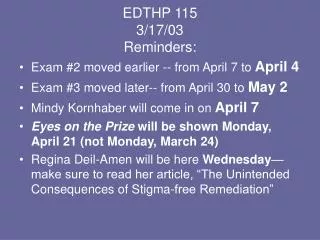
EDTHP 1153/17/03Reminders: • Exam #2 moved earlier -- from April 7 to April 4 • Exam #3 moved later-- from April 30 to May 2 • Mindy Kornhaber will come in on April 7 • Eyes on the Prize will be shown Monday, April 21 (not Monday, March 24) • Regina Deil-Amen will be here Wednesday—make sure to read her article, “The Unintended Consequences of Stigma-free Remediation”
Where we’ve been, where we are, where we’re heading • Educational Policy • Examined Reform strategies currently being employed throughout the country • School Effectiveness in the U.S. • International Issues in Education • History of Education: • Puritans • Education in the New Republic and early plans for systems of education • Common Schools, Part I • Other “educational” forces--role of Disney, Media, etc. • How to get a teaching job
Where we are, where we’re heading (con’t.) • Financing Public Education • Philosophy of Education • History of Education: • The Progressive Era, 1890s-1940s • Sociology of Education • Chap. 10: • Agents of Socialization: Family, Peers, and School, TV and Media • Gender Roles, Adolescents and Adolescence
Where we are heading (con’t.) • Chap. 11: • Race • Class • School Achievement • Different Interpretations of the above Big Question: Do schools alleviate or reinforce social inequalities?
Philosophies • Idealism • Realism • Pragmatism • Existentialism
Theories of Education • Progressivism • Scientific Management • Social Reconstructionism • Existentialism • Perennialism • Essentialism
Common School Reforms Revisited • We talked about schools and conditions in early 1800s • Talked about common school reform movement … reformers did see it as a movement … had a clear agenda, found ways to enact it through legislation and other means—and were rather successful • Often one period’s successes lead to problems for the next generation to solve. Remember: education is always changing; we are always attempting to address new challenges, needs, circumstances • And so it was with the common school reforms. Led perhaps to too much standardization and uniformity
New Challenges/Problems of the 1890s and early 1900s • Immigration • Industrialization • Urbanization
Importance of Education in the Progressive Era • New Views of Children and Schooling • New Curricula • New Ways of Classifying Children • New Philosophies and Theories • New Structures: Kindergarten; Junior High; High School; Junior College • New Practices • Overall—The Establishment of Many Ideas, Structures, and Practices That Remain Today
General Goals of Progressive Educators • Schools should be adapted to the child, instead of adapting children to schools • The curriculum and instructional practices should be “modernized” • Away from the overly rigid, mechanized, “lock-step” instruction of the 1800s • Schools should meet the needs of the whole child—intellectual, physical, emotional • Schools should meet new needs of society
General Educational Goals 1. Schools should be adapted to the child, instead of adapting children to schools • Helen Todd, “Why Children Work,” 1913
General Educational Goals (con’t.) 2. The curriculum and instructional practices needed to be modernized • Joseph M. Rice, Education in the United States, 1893 • John Dewey, The School and Society 1899
General Educational Goals (con’t.) • Schools should meet the needs of the whole child—intellectual, physical, emotional
General Educational Goals (con’t.) • Schools should meet new needs of society • Transformation of education • Dewey [perhaps also from school and society
John Dewey 1890s 1930
Dewey’s Main Ideas • A commitment to democratic education • Authoritarian schools a disservice to society • Students should be free to test all ideas and values • Classrooms should be places where students learn to experience, engage directly in life activities, and learn to work together • Child-centeredness balanced with Subject-centeredness • Importance of scientific method
Pedagogical Progressives • John Dewey (1859-1952) • School and Society, 1899 • Education and Democracy, 1916 • Experience and Education, 1938 • William H. Kilpatrick • The Project Method • Progressive Education Association
Administrative Progressives Ellwood P. Cubberley, Stanford Professor and Reformer (Scientific Management) • Take schools out of politics • Base education on science not tradition • Efficient management of schools • Differentiate structure • Classify and differentiate students • Assimilate immigrants • Education is part of the battle in international competition