Download
1 / 12
120 likes | 268 Vues
This analysis by Brandon Basuil and Edward Lopez, supervised by Prof. Tanvi Patel, examines the effects of video games on aggression and materialism within individuals and families. With statistics highlighting that 67% of U.S. households engage in gaming, the paper addresses critical issues like obesity, loss of interpersonal skills, and time management. Suggested solutions include parental controls, therapy for addicted gamers, and promoting sports for emotional outlets. The discussion emphasizes the need for responsible gaming habits in our communities.

E N D
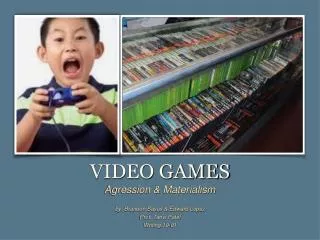
VIDEO GAMES • Agression & Materialism • by: Brandon Basuil & Edward Lopez • Prof. Tanvi Patel • Writing 10-01
HISTORY AND FACTS • The First Home-Console was the “Odyssey” created by Ralph Bear • According to ESRB (Entertainment Software Rating Board), in 2010: • 67 % of US Households play video games. • Average gamer spends 8 hours a week playing video games.
THINGS TO CONSIDER What are the issues? • Who does it affect? As an individual? As a family? As a community? What are some solutions? What are some solutions not brought up?
WHAT ARE THE ISSUES? • Aggression Obesity Loss of Human Interactions Time Management Reality vs. Virtual Reality
Solutions not created or enforced Solutions • Create time limits on the video games. • Present “On-the-spot” demos to the parents to show the contents of the video game. • For easily raged gamers, exert the rage into curricular activities, such sports. • Censorship • Go to therapy classes • Parenting skills, more strict on video games http://www.youtube.com/watch?v=AHnslBhmR7Q&list=TL3XlrIGYWnFd686aCgYVVSNjrgP5Txadp Start at 5:15
By Edward Lopez Video games materialize gamers
Why do gamers become materialistic? • The feeling of Success. • -motivation to play • Fantasy World Identification. • Get emotionally attached
The problem with materialistic gamers. • Exterior Focus • Time management • More desire for material goods.
Work Cited Dike Van De Mheen, et al. "Video Game Addiction And Social Responsibility.” AddictionResearch & Theory 18.5 (2010): 489-493. Academic Search Complete. Web. 15 Oct. 2013 Essig, Todd. "The Addiction Concept And Technology: Diagnosis, Metaphor, Or Something Else? A Psychodynamic Point Of View." Journal Of Clinical Psychology 68.11 (2012): 1175-1184. Academic Search Complete. Web. 22 Oct. 2013. Fish, Stanley. "How to Recognize a Poem When You See One." Acts of Inquiry. Ed. Allison Gross, Annie Dwyer, David Holmberg, and Anis Bawarshi. Boston: Bedford/St. Martin, 2010. 407-18. Print. Harding, Anne. "Violent Video Games Linked to Child Aggression." CNN. Cable News Network, 2008. Web. 25 Sept. 2013. <http: edition.cnn.com/2008/HEALTH/family/11/03/healthmag.violent.video.kids/>. Kearney, Paul, and Maja Pivec. "Sex, Lies And Video Games." British Journal Of Educational Technology 38.3 (2007): 489-501. Academic Search Complete. Web. 22 Oct. 2013. Keim, Brandon. "What Science Knows About Video Games and Violence." PBS. PBS, 28 Feb. 2013. Web. 25 Sept. 2013. <http://www.pbs.org/wgbh/nova/next/body/what-science-knows-about-video-games-and-violence/>. Norcia, Andrea. "Parents & Teachers: The Impact of Video Games." Parents & Teachers: The Impact of Video Games. Adolescent Interest Group, Aug. 2013. Web. 25 Sept. 2013. <http://www.pamf.org/parenting-teens/general/media-web/videogames.html>.
Work Cited Reisinger, Don. "91 Percent of Kids Are Gamers, Research Says." CNET News. CBS Interactive, 11 Oct. 2011. Web. 23 Sept. 2013. <http://news.cnet.com/8301-13506_3-20118481-17/91-percent-of-kids-are-gamers-research-says/>. Young, Kimberly. "Understanding Online Gaming Addiction And Treatment Issues For Adolescents." American Journal Of Family Therapy 37.5 (2009): 355-372. AcademicSearch Complete. Web. 1 5 Oct. 2013.