CAPACITORS
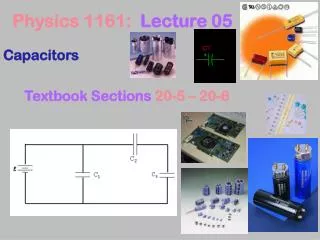
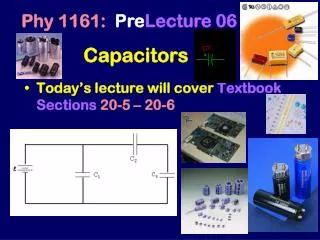
Capacitors are essential electrical devices capable of storing electric charge, akin to temporary batteries. Comprising two conductive plates separated by a small gap, they charge when connected to a battery, where capacitance (C) is defined as C=q/V, measured in farads (F). The capacitance depends on plate area (A) and distance (d). Applications range from keyboards detecting keystrokes to energy storage in cameras and defibrillators. Understanding capacitance principles is crucial for effective utilization in electronic circuits.

CAPACITORS
E N D
Presentation Transcript
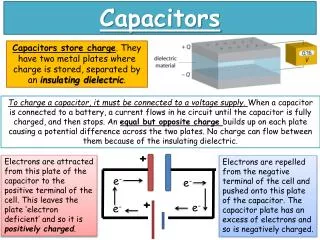
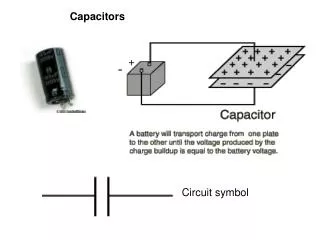
CAPACITORS • A device that has the capacity to store electric charge energy • A temporary battery • Nothing more than two conducting plates separated by small distance • Connecting this to a battery causes plates to become charged • The greater the charge for a given voltage the greater the capacitance • Batteries with varying voltage cause varying charges, turns out they are proportional • The constant that creates the equality = capacitance, C
C = q / V • Unit: C / V = farad, F (named after Michael Faraday) • Q = magnitude of charge on either plate • V = voltage difference between plates • 1 F capacitor has a huge capacitance • Large capacitance = large ability to store charge energy
Parallel Plate Capacitor • Only type we consider • Two parallel plates of area, A separated by distance, d • As charge is “pulled” from one plate and “placed” on the other because of the battery and E-field is created within plates • We say the E-field stores energy
Parallel Plate Capacitor – Cont. • To calculate capacitance: C = ε0 A / d • Where ε0 = permittivity of free space = 8.85 x 10⁻¹² C2/N m2 • A fundamental constant • As A increases, the surface area increases = more room to store charge • Therefore C increases • The closer the plates are together, d decreases, the larger the capacitance
A computer keyboard uses variations in capacitance to “know” whether a key is depressed • The musical instrument, Theremin, uses an antenna as one plate and a hand as another • Zeppelin's Whole Lotta Love • http://www.youtube.com/watch?v=w5qf9O6c20o
Electrical Energy Storage • Consider a charged parallel plate • Imagine transferring a small amount of charge, Δq from one plate to the other • Charge must be moved across V, takes energy ΔU = (Δq) V • As more charges are moved, more work is done more energy stored
Recall: C = q / V V = q / C • Voltage increases linearly with charge • Total energy, U = q Vave= q (V1 + V2)/2 = ½ q V • U = ½ q V • Using definition of capacitance, it’s possible to create 2 other equivalent formulas • Energy stored is used in cameras with flash • Defibrillators also use capacitors • Capacitors store charge for extended periods of time and can be quite dangerous