Download
1 / 20
200 likes | 342 Vues
This report provides an overview of the Southern California Coastal Water Research Project's (SCCWRP) work on developing benthic community condition indicators. It summarizes the response to comments on the revised workplan, highlights progress made since the initial SSC review, and outlines key tasks such as identifying naturally occurring assemblages, refining existing indicators, and evaluating field sampling methods. Preliminary results and anticipated milestones for each task are also discussed, aimed at enhancing understanding of benthic community conditions in Southern California's coastal waters.

E N D
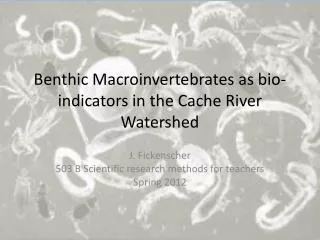
Benthic Community Condition Indicators Ananda Ranasinghe Southern California Coastal Water Research Project (SCCWRP) AnaR@sccwrp.org
Overview • Response to Comments on Revised Workplan • First SSC review in August 2004 • Revised Workplan in October 2004 • Comments received March 2005 • Report on Progress and Schedule • Work accomplished since August review • Including a few preliminary results
Overview of Comments • Mainly requests for clarification • We are glad to provide them • No task or subtask additions or deletions were suggested • Some adjustments are appropriate • A comment or two addressed issues we had not considered
Today’s Talk • Is Organized by Task • For each Sub-Task • Progress • Anticipated completion milestones • Preliminary results • If available for the task • Comments and Clarifications
Benthic Indicators Workplan • Develop Benthic Community Condition Indicators • Task 1: Identify Naturally Occurring Assemblages • Task 2: Refine Existing Indicators • Task 3: Compare and Evaluate Indicators • Identify Effective Field and Lab Methods • Task 4: Evaluate Field Sampling Methods • Task 5: Develop Taxonomy QA
Task 1: Identify Naturally Occurring Communities Defines habitat strata for benthic indicator development Sub-Task 1.1 Assemble database Complete Sub-Task 1.2 Analyze Data In Progress; Completed by end of April 2005 Sub-Task 1.3 Report Expected June 2005
Assemblage Analysis Methods • Data from 8 Regional Projects • 1131 taxa from 1164 stations • Habitat, sediment chemistry and toxicity data available • Collected using 1-mm sieve • Methods and taxonomy reviewed and, if necessary, adjusted • Eliminated potentially contaminated sites and singleton taxa • Analyzed 881 taxa from 714 stations • Cluster Analysis • Cube-root transform, Bray-Curtis dissimilarity index, Flexible sorting β=-0.25
Task 1: Responses to SSC • Why are sediment chemistry and toxicity data necessary? • To eliminate contaminated sites • The products should include more than a map • We agree. Publication in a peer-reviewed journal and project-specific reports are planned
Task 2: Refine Benthic Indicators • The scope of this task has expanded • Six indicator approaches will be improved, developed and assessed • Three approaches are currently used in CA • BRI, IBI, RBI • Three other possibilities • RIVPACS, BWI, Conventional measures • Taking advantage of the availability of experts
Task 2 Sub-Tasks 2.1 Assemble southern California and San Francisco Bay Index Development database • Compiling the data base from different sources, and reviewing methods and taxonomy for compatibility has been more time consuming than expected • In progress; Completion expected by April 30, 2005 2.2 Data Analysis to develop and refine benthic indicators • Habitats defined in Task 1 determine Index Refinement Strata • Indices will be developed and refined separately in each stratum • Scheduled to begin April 2005 2.3 Present Results • Scheduled for June 2005
Task 2: Responses to SSC • Does “refine” mean recalculate with the improved and expanded database? • Yes • Will all indices carry forward to Task 3 • Yes
Task 3: Compare and Evaluate Benthic Indicators • Develop a benthic indicator development strategy based on • Validation using independent data • Comparison of the indicators • Magnitude of season and habitat effects • Magnitude and sources of uncertainty • To begin in June 2005
Comparisons in Southern California • 155 samples Mexico to Pt. Conception • 78.1% agreement • Assessment error is low relative to measurement error Percent ofsamples
Task 3: Responses to SSC • Task 3 should include an evaluation process leading to a single state-wide index • Unlikely to be a single index because multiple habitats require separate index development • Indices for all habitats will be normalized to the same scale • Any indices used in any area should be on a common, easily understandable scale • We agree and this is our goal • Are “ecologically appropriate thresholds” sensu Smith et al. 2001? • Yes
Task 4: Evaluate Field Sampling Methods Identify gear and sieve size effects on benthic indicator results Sub-Task 4.1 Assemble database Samples collected, laboratory processing in progress, existing data compilation in progress Sub-Task 4.2 Data Analysis Will begin September 2005 Sub-Task 4.3 Report Anticipated December 2005
Task 4: Responses to SSC • Will this task lead to a set of required protocols, as in Puget Sound? • Our initial focus is on gear effects on assessments • It will lead to recommendations • Will recommendations be state-wide or region-specific? • Ideally they will be state-wide
Task 5: Develop Taxonomy QA Procedures • Develop procedures to assure repeatability of indicator measurements • We plan to build on existing EMAP and SCCWRP models • Model include • Achieving completeness measures for sorting • QA re-identification of a percentage of samples by a different lab • Completion June 2006 • Necessary accuracy will depend on indicator approach(es) selected
Task 5: Responses to SSC • How will partial organisms be treated? • Usually, heads are counted for mobile animals and bases for sessile animals • How will epifauna be treated? • Epifauna are typically eliminated • They have reduced exposure to sediments • They may be more indicative of habitat structure (e.g., shell hash) than sediment condition
Benthic Indicators Workplan • Develop Benthic Community Condition Indicators • Task 1: Identify Naturally Occurring Assemblages • Task 2: Refine Existing Indicators • Task 3: Compare and Evaluate Indicators • Identify Effective Field and Lab Methods • Task 4: Evaluate Field Sampling Methods • Task 5: Develop Taxonomy QA